
In the sun-drenched expanse of the African bush, your riding jacket is less of a garment and more of a life-support system. You’ve likely felt the suffocating weight of heavy leathers as the midday sun beats down, or the sudden, bone-deep chill that settles in when you ascend from the coast into the mist-shrouded peaks. It’s a delicate balance to strike. Selecting the right motorcycle gear for South African climate is the difference between a gruelling endurance test and a sublime journey of discovery.
Discover how to curate the perfect technical kit to remain cool, safe, and comfortable whilst traversing these diverse landscapes. Since our support vehicles carry your spare gear, you can adopt a more technical, lightweight approach to your riding wardrobe. We’ll explore the essential layers that offer maximum protection without the bulk, allowing you to ride with absolute confidence in your physical endurance. From high-performance ventilation to moisture-wicking fabrics, this guide ensures your focus remains on the raw beauty of the road ahead.
Key Takeaways
- Master the art of managing extreme UV intensity and rapid temperature shifts as you traverse the vast landscapes from sea level to ancient mountain peaks.
- Discover the science of evaporative cooling to ensure you select the most effective motorcycle gear for South African climate conditions without compromising on safety.
- Learn why adventure-style helmets and external shells are superior for shielding against the raw elements of the bush, from fine dust to sudden torrential rain.
- Implement a sophisticated three-layer system that allows you to adapt instantly to changing environments, utilising our support vehicles to remain lightweight and agile.
- Curate a high-performance kit that reflects a refined professionalism, ensuring you look as composed at a luxury lodge as you do whilst on the road.
Understanding the Dynamics of the South African Climate
South Africa is a land of visceral contrasts. From the mist-shrouded peaks of the Drakensberg to the sun-baked plains of the interior, the South African Climate demands a gear strategy that’s as versatile as the terrain. Choosing the right motorcycle gear for South African climate requires moving beyond standard European assumptions; here, you’re contending with a unique blend of high-altitude solar intensity and rapid atmospheric shifts. Traditional black leathers, whilst iconic, are often the wrong choice for the African interior. They act as relentless heat sinks that rapidly drain a rider’s stamina, turning a scenic tour into a test of thermal endurance.
On the Highveld, riders must prepare for a specific atmospheric phenomenon: the sudden, violent afternoon thunderstorm. These storms arrive with a theatrical intensity, dropping the mercury by fifteen degrees in mere minutes and drenching the landscape in a wall of water. Without a technical kit that can be adjusted on the fly, you’ll find yourself either sweltering in waterproofs or shivering in sodden mesh. Because our support vehicles follow every journey, you have the luxury of switching layers as these conditions evolve, ensuring you stay focused on the road rather than the weather.
The Impact of Solar Radiation on Rider Fatigue
The African sun is a physical weight. High UV intensity doesn’t just burn the skin; it accelerates dehydration and mental fatigue by forcing the body to work overtime to regulate its core temperature. Light-coloured gear is essential here, as it reflects a significant portion of radiant heat away from the body. The heat-exhaustion-to-error ratio dictates that as a rider’s core temperature rises, their cognitive processing speed and reaction times diminish in direct proportion to their physical discomfort. Staying cool isn’t just about luxury; it’s a fundamental safety requirement for the long, sweeping roads of the bush.
Regional Variations Without the Map
Transitioning from the humid coastal air to the bone-dry heat of the interior is a sensory shock that many riders underestimate. A single day’s ride can easily involve a 20-degree temperature swing as you climb from sea level to the high plateaus. Generic “all-season” gear often fails in these true African extremes because it tries to do too much without mastering the specifics of high-performance ventilation. You need a modular system that can breathe in the humidity and insulate against the crisp mountain air. By using our expert guides’ real-world testing, you can curate a kit that handles these fluctuations with professional ease.
The Ventilation Hierarchy: Staying Cool Without Compromising Safety
Airflow is the fundamental currency of comfort when you’re crossing the Karoo or navigating the humid corridors of the coast. To master the art of staying cool, one must understand the science of evaporative cooling. As you move at speed, air rushing through your kit carries away moisture and heat, but this process requires precision. High-performance motorcycle gear for South African climate relies on “forced ventilation” ports. These are specifically engineered intake and exhaust vents in helmets and boots that create a vacuum effect, pulling heat away from your head and feet even in stationary traffic. Key benefits of these ports include:
- Continuous heat extraction: Exhaust vents at the rear of the helmet pull hot air out, preventing a “greenhouse effect” inside the lid.
- Strategic foot cooling: Intake vents on the shins and toes of boots allow cool air to circulate around the ankles, a critical pulse point for body temperature.
- Reduced mental fatigue: Keeping the head cool maintains cognitive clarity during technical off-road sections.
Whilst South African motorcycle law mandates the use of a certified helmet, your physical safety in the heat depends on a full suite of ventilated equipment. The choice between full mesh and vented textile is a matter of environment. Mesh offers the most visceral connection to the breeze, but high-quality vented textiles often provide better structural integrity for carrying the technical tools required on a long-range safari. Selecting the right motorcycle gear for South African climate means finding that sweet spot where you don’t feel the weight of your protection.
Technical Mesh and Abrasion Resistance
Modern technical mesh has evolved far beyond simple netting. Today’s high-tenacity polymers allow for immense airflow whilst maintaining the abrasion resistance required for high-speed slides. The secret lies in the strategic placement of these panels. Designers focus mesh on high-heat zones like the chest and inner arms, whilst keeping solid, reinforced textiles on impact points like shoulders and elbows. For the ultimate setup, ensure your armour is also ventilated. Level 2 vented protectors feature a honeycomb structure that allows heat to escape from the very points where traditional pads trap it against your skin.
Hydration Systems: The Unsung Hero of Your Kit
Physical endurance is fueled by hydration. Integrating a hydration bladder directly into your jacket or a dedicated backpack is a non-negotiable for the serious explorer. The psychological benefits of constant, small sips of water far outweigh the effect of large gulps during infrequent stops. It keeps your focus sharp and your reactions fluid. This level of preparation is what separates a standard ride from an experienced guided motorcycle adventure South Africa. By maintaining your internal temperature, you’re free to absorb the majesty of the landscapes without the fog of dehydration. If you’re ready to put these technical principles into practice, our Kruger Park & Panorama Route Tour offers the perfect proving ground.
Environmental Resilience: Shielding Against Dust, Wind, and Rain
Beyond the heat, the African wilderness presents a relentless barrage of environmental challenges that can compromise even the most seasoned rider. The pervasive red dust of the interior is more than a nuisance; it is a fine abrasive that seeks out every seal and zip. Effective motorcycle gear for South African climate must act as a sophisticated barrier against these elements. Whilst many riders rely on internal waterproof membranes, these often lead to the “Boil-in-the-Bag” phenomenon. In 35-degree heat, an internal liner traps your body heat and perspiration so effectively that you’ll find yourself drenched from the inside out long before the rain arrives. A professional approach involves choosing outer shells that repel dust and moisture at the surface, keeping your technical layers breathable and your core temperature stable.
Dust management is equally critical for physical endurance. A neck gaiter or buff is a simple yet indispensable tool; it protects the sensitive skin of the neck from sun-scorch whilst preventing grit from entering your jacket. This attention to detail ensures you remain composed and ready to spot wildlife in the untamed bush, rather than being distracted by the visceral discomfort of windburn or grit. By leveraging our support vehicles, you can carry dedicated shells for these shifts in environment, ensuring your primary kit remains lightweight and ventilated.
Mastering the Afternoon Downpour
When those sudden Highveld storms break, speed is of the essence. External rain over-jackets are superior to integrated membranes because they can be donned in seconds over your mesh gear, providing an instant shield that keeps the weight of the water off your primary kit. To keep your extremities dry during a flash flood, look for gloves with over-the-cuff seals and boots with high-performance gussets. Your base layers are your last line of defence; always opt for moisture-wicking synthetic fabrics. Cotton is a liability in the bush because it holds onto moisture, leading to rapid cooling once the storm passes and the wind-chill takes over.
Dust and Vision: Helmet Selection
Vision is your most valuable asset when traversing diverse landscapes. Adventure-style helmets are the gold standard here, as their peaks reduce eye strain during the “golden hour” when the sun hangs low over the horizon. Even in the heat, dual-pane visors and Pinlock systems are essential to prevent fogging during sudden temperature drops. Modular helmets are a favourite amongst Harley Davidson tours South Africa riders, as they allow for the convenience of an open-face view during low-speed scenic stretches whilst providing full-face protection and dust sealing when the pace quickens on the open road. This flexibility ensures you never miss a moment of the majestic scenery due to a compromised field of view.
The Adventure Rider’s Layering System: A Step-by-Step Guide
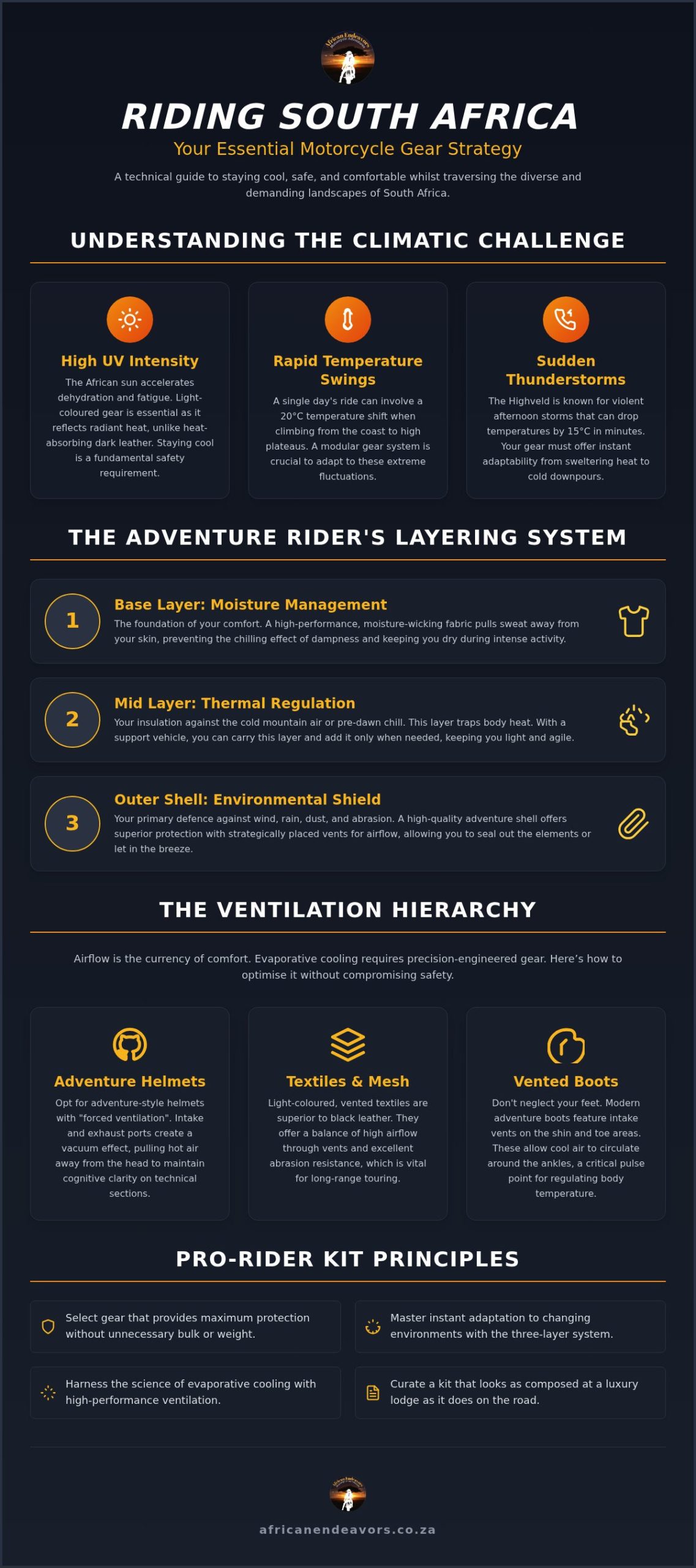
To master the diverse landscapes of the interior, one must move away from viewing equipment as individual purchases and instead embrace a cohesive technical system. The three-layer philosophy, comprising a high-performance base, a protective armour layer, and a resilient outer shell, is the gold standard for selecting motorcycle gear for South African climate. This modular approach allows you to adjust your micro-climate whilst on the move, ensuring you remain physically fresh whether you’re navigating a humid coastal pass or a dry mountain trail. By treating your kit as a personal ecosystem, you maintain the mental clarity required for technical riding.
The Base Layer: Your Personal Thermostat
Your base layer is the most critical component for skin health and moisture management. Whilst Merino wool is lauded for its thermal properties, synthetic high-performance fabrics often edge it out in the intense African sun due to their superior capillary action, which pulls moisture away from the skin at a faster rate. Interestingly, long sleeves are actually cooler than short sleeves under a technical jacket; they provide a continuous wicking surface that facilitates evaporative cooling whilst preventing the visceral discomfort of armour rubbing against bare skin. Compression gear further enhances this experience by reducing muscle oscillation and fatigue during demanding off-road sections, allowing for quicker recovery after a long day in the saddle.
The Mid-Layer: Managing the Mountain Chill
Early morning starts in high-altitude regions require a mid-layer that can be shed with precision as the sun climbs. A lightweight windbreaker or a packable down vest is ideal for these transitions, offering significant thermal protection without the bulk of traditional liners. Because our support vehicles carry your spare equipment, you don’t need to overstuff your tank bag. You can swap from a thermal mid-layer to a ventilated shell during a mid-morning stop with effortless precision. This flexibility is essential when transitioning from the crisp air of the peaks to the radiant heat of the valleys below.
Do not overlook the technical requirements of your feet. An 8-hour riding day can lead to the painful phenomenon of “boot-burn” if you wear standard cotton socks that trap moisture and cause friction. Technical motorcycle socks, engineered with padded impact zones and moisture-wicking fibres, are essential for maintaining skin health inside heavy adventure boots. This level of detail ensures that your physical endurance remains uncompromised from head to toe. Ready to test your technical kit on the most iconic routes in the country? Book The Wild Coast & Drakensberg Tour for a masterclass in high-altitude adventure.
Curating Your Kit for a Professional Guided Safari
Transitioning from a casual weekend ride to a multi-day expedition requires a fundamental shift in your equipment strategy. On a professional safari, your needs evolve from basic protection to long-term environmental endurance. The ultimate luxury of our service is the presence of a dedicated support vehicle. This allows you to select highly specific motorcycle gear for South African climate without the burden of strapping heavy luggage to your machine. You can carry a dedicated mesh jacket for the sun-drenched lowlands and a robust, armoured shell for the mountain passes, switching between them with effortless precision as the landscape shifts.
There is also a social dimension to consider on a premium tour. When you arrive at a luxury lodge after a day spent traversing the raw beauty of the bush, your appearance should reflect a sense of refined professionalism. Many modern technical garments now feature “stealth” styling; these pieces offer world-class protection whilst looking composed and understated at a formal dinner table. By choosing gear that bridges the gap between the trail and the lodge, you maintain a standard of hospitality that matches the high-end nature of the experience.
The African Endeavors Advantage
Our support vehicles ensure you ride unencumbered, leaving your bike light and agile for the technical sections of the Drakensberg or the Wild Coast. This isn’t merely a convenience; it’s a performance advantage that reduces physical strain and allows you to absorb the sensory details of the journey. Our mechanical team is always on hand to assist with gear adjustments, from fine-tuning helmet seals to ensuring your boots are properly treated for the day’s terrain. If you’re planning a private group journey, our bespoke motorcycle safari South Africa service provides custom gear advice tailored to your specific itinerary and group requirements.
Final Preparation: The 30-Day Gear Check
Preparation is the hallmark of a professional rider. You should never arrive for a multi-day expedition with brand-new, untested equipment. Breaking in new boots is the most critical task; a stiff, unyielding boot can lead to blisters that compromise your focus on the road. Wear your boots for at least 20 hours of riding before you land. Take the time to clean and re-waterproof your textile shells, ensuring they’re ready to repel the fine red dust of the interior. Finally, verify that your helmet comms are fully updated and compatible with the group. This ensures seamless coordination with our guides, allowing the entire team to move as a single, professional unit through the untamed landscapes.
Mastering the African Horizon
Traversing the untamed beauty of the Drakensberg or the Wild Coast requires more than just a machine; it demands a technical mastery of your environment. You’ve learned that selecting the right motorcycle gear for South African climate is a modular science, balancing the visceral need for airflow with the uncompromising necessity of protection. By embracing a sophisticated layering system and leveraging the luxury of a support vehicle, you transform a demanding expedition into a curated adventure where every mile is savoured. Our expert local guides, who’ve spent over a decade navigating these iconic routes, ensure every logistical detail is handled with meticulous care.
Whether you choose a high-performance BMW or KTM for the rugged interior or a premium Harley Davidson for a scenic coastal cruise, our fully supported tours provide the ultimate front-row ticket to the wild. The road’s calling. You’re now equipped with the professional knowledge to answer it with absolute confidence. Book your fully supported South African safari with African Endeavors today and step into a world of raw discovery and refined hospitality. Your journey of a lifetime awaits under the vast African sky.
Frequently Asked Questions
Is leather or textile better for riding in South Africa?
Textile is the superior choice for the diverse South African landscape because it offers the ventilation and modularity that leather simply cannot match. Whilst leather provides iconic protection, it often becomes a heat trap in the interior. Modern high-tenacity textile gear allows for integrated mesh panels and moisture-wicking liners. This versatility is essential when transitioning from high-altitude mountain passes to humid coastal stretches during a multi-day safari.
Can I wear a motocross helmet for a long-distance road safari?
We don’t recommend a pure motocross helmet for long-distance road safaris due to the excessive wind noise and lack of a sealed visor. These lids are designed for high-intensity, short-duration off-road work. For a professional tour, an adventure-style helmet is the gold standard. It features a peak for sun protection and a flip-down visor that shields you from the fine red dust and insects encountered on open-road stretches.
What is the best colour for motorcycle gear in the African sun?
Selecting light-coloured motorcycle gear for South African climate conditions is a critical safety decision. Light greys, tans, and whites reflect solar radiation, whereas black gear absorbs heat and rapidly increases your core body temperature. This thermal management reduces physical fatigue and keeps you mentally sharp. Choosing a lighter palette ensures you remain comfortable during long, sun-drenched days in the bush without sacrificing any protective capabilities or aesthetic professionalism.
How do I stay hydrated whilst riding for 8 hours in the heat?
Constant hydration is achieved through a technical hydration bladder integrated into your riding jacket or a dedicated backpack. Sipping small amounts of water every fifteen minutes is far more effective than drinking large volumes during infrequent stops. It maintains your cognitive processing and prevents the onset of heat exhaustion. Our support vehicles always carry chilled water and electrolytes, allowing you to refill your system at every scenic waypoint.
Do I need different gear for the Drakensberg mountains vs. the coast?
You absolutely need a modular system to handle the contrast between the mountain peaks and the coast. The interior often presents crisp, high-altitude air and sudden mist, necessitating a windproof mid-layer. Conversely, the coast is defined by high humidity and radiant heat where maximum ventilation is paramount. Because our support vehicle carries your luggage, you can easily swap between a ventilated mesh shell and a technical insulated layer as the elevation shifts.
What happens to my gear if it rains during a guided tour?
If the clouds break during a tour, we rely on the support vehicle to provide instant access to your rain gear. We recommend high-visibility external rain shells that can be donned in seconds over your primary kit. These shells keep the weight of the water off your jacket, preventing the sodden feeling of saturated textiles. Once the storm passes, you can simply stow the wet gear back in the vehicle and continue riding in dry comfort.
Should I bring my own gear or can I hire it in South Africa?
We strongly suggest bringing your own helmet, gloves, and boots to ensure a perfect, personal fit. Broken-in boots are essential for preventing discomfort during a multi-day expedition. Whilst we provide high-performance motorcycle rentals, using your own protective kit ensures you are familiar with every zip and vent. If you have specific requirements for a private group, we can provide bespoke advice on what to pack for your chosen itinerary.
Are adventure boots necessary or can I wear standard road boots?
Adventure boots are a non-negotiable requirement for the varied terrain of the bush. Standard road boots lack the lateral stiffness and shin protection needed when navigating gravel sections or avoiding low-lying brush. A professional adventure boot provides a robust shield against impact whilst remaining comfortable enough for the social aspects of the tour at luxury lodges. It’s an investment in your physical safety that pays dividends on every technical trail.
