
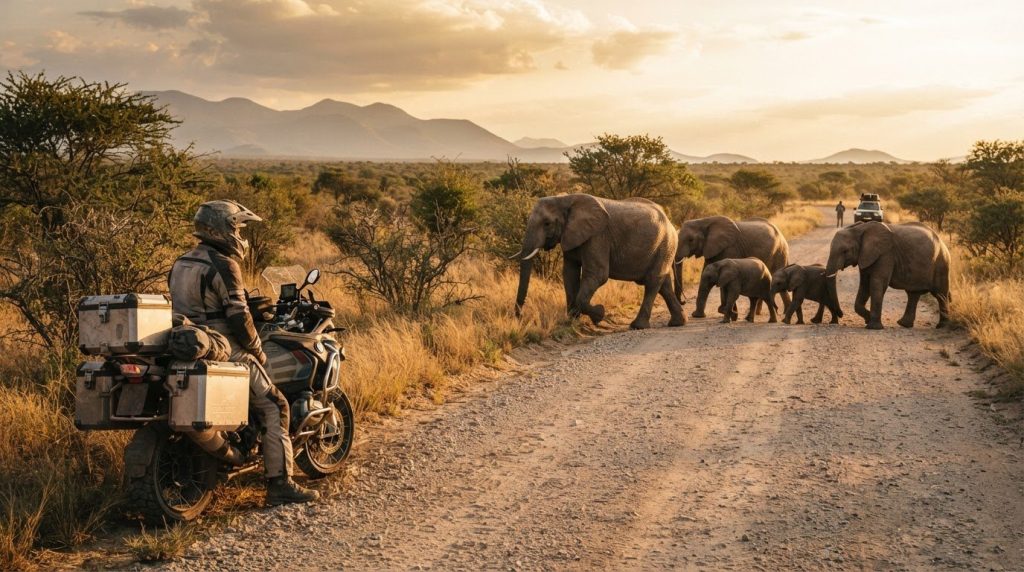
What should you do when wildlife appears on the road ahead: keep moving, stop or turn back? The uncertainty is understandable. A motorcycle’s sound and movement can feel intrusive, and it isn’t always easy to judge what to do in a sudden encounter. Dealing with wildlife on a motorcycle safari starts with patience, space and calm, guide-led decisions, not trying to get closer for a better view.
A motorcycle safari doesn’t necessarily mean riding through a national park. Motorcycle access is restricted in some places, and rules vary by location. Wildlife may still be encountered on roads between protected areas, so knowing how to respond matters. This guide explains how to prepare, observe animals respectfully and make considered choices if one appears on your route. You’ll also learn why following your guide’s instructions is essential, and how a professionally guided, supported tour can make some of the planning clearer without controlling what wildlife does.
Key Takeaways
- When dealing with wildlife on a motorcycle safari, prioritise space and observation over getting closer for a better view.
- Wild animals aren’t performing for visitors, and their behaviour can be difficult for inexperienced riders to interpret.
- A guided safari can help you make informed decisions, but it can’t remove the unpredictability of wildlife encounters.
- If an animal appears, use the general guidance in this article, then follow your lead guide and the relevant land manager’s rules.
- Pre-ride briefings and organised tour logistics can help you prepare. A support vehicle carries luggage and provides mechanical assistance.
Dealing with wildlife on a motorcycle safari: why distance comes first
A sighting can stop you in your tracks: a powerful shape moving through the bush, the road opening onto a wild landscape, the instinct to take a closer look. Resist that instinct. A responsible encounter means observing without approaching, crowding or provoking an animal, and accepting that the view may be brief or distant.
Distance alone can’t guarantee safety. Animal behaviour, visibility and road conditions can change, and no encounter should be assumed safe. Human activity and wildlife can come into conflict over space and resources, as outlined in this introduction to human-wildlife conflict. On safari, restraint helps avoid adding unnecessary pressure to an encounter. Your guide’s instructions and the applicable rules set by the park, reserve or land manager always take precedence over general advice in this article.
What makes a motorcycle wildlife encounter different?
On a motorcycle, you’re exposed to your surroundings rather than separated from them by an enclosed vehicle. That can make a sighting feel immediate, but it also means you should be deliberate about your actions. Avoid sudden movement, unnecessary noise or attempts to attract an animal’s attention. Wildlife won’t respond uniformly, so don’t assume an animal will ignore a bike or react predictably.
Keep the distinction clear: riding on a route where motorcycles are permitted doesn’t give you permission to enter a restricted area or approach wildlife. Follow the designated route and your guide’s directions. If the route or access rules are unclear, ask your guide rather than making your own interpretation.
Which animals call for particular caution?
African elephant, African buffalo, lion, leopard and rhinoceros are examples of wildlife to treat with care, not a ranking of risk. Behaviour varies by species and situation, and a brief view may not tell you what an animal will do next. Don’t rely on a fixed distance or attempt to interpret a particular posture as proof that it’s safe to move closer. Leave that judgement to your guide, who can apply local knowledge and the relevant site rules.
Wildlife safety depends on distance, restraint and following the guide’s instructions. That principle is central to dealing with wildlife on a motorcycle safari: observe calmly, give animals room and let the person leading the ride direct the response. The thrill of a close-to-nature journey is real, but a respectful sighting never depends on getting closer.
How wildlife behaviour shapes a motorcycle safari encounter
A wild animal isn’t performing for visitors, and a sighting rarely unfolds to a script. The same sound or movement may be met differently depending on the animal and what’s happening around it. For riders, the practical lesson is simple: observe what you can see, but don’t assume you know what the animal will do next.
Why animals may react differently to bikes and people
Sound, movement, distance and an animal’s immediate context can all matter, but a rider can’t reliably predict how a particular animal will respond. Engine noise isn’t a dependable way to deter wildlife or make a motorcycle safer. Never test an animal’s reaction by revving, approaching or following it. Those actions can disturb wildlife and bring you closer than you should be.
Research discussed by Africa Geographic on elephant responses to safari vehicles offers useful context for why vehicle proximity and guide behaviour deserve attention. It isn’t a set of instructions for every species or motorcycle encounter, so rely on your guide and current guidance from reputable wildlife or conservation authorities for practical decisions.
Reading a sighting without treating it as predictable
Notice what’s visible, such as an animal’s location and direction of movement, but don’t turn a brief observation into a confident diagnosis. An animal that appears still may move, change direction or respond to something you haven’t seen. Terrain, limited visibility and other vehicles can also affect what you notice and the space available to respond. Keep a clear view where possible, avoid crowding other vehicles and leave room rather than pressing closer.
No single sign guarantees that a wild animal is relaxed or safe to approach. If you’re unsure what you’re seeing, ask your guide instead of interpreting the animal’s behaviour yourself. This is especially important for inexperienced riders, who may have little basis for judging what a particular movement means. Calm observation helps protect both people and wildlife from unnecessary disturbance.
Good preparation includes learning how your guide wants the group to respond to sightings and checking that advice against the rules of the relevant land manager. If you’re considering a professionally guided journey, exploring guided motorcycle safari options can help clarify the tour arrangements and briefing support available. The aim isn’t to predict wildlife. It’s to make measured choices when the unexpected appears.
Motorcycle safari myths: does wildlife make riding too dangerous?
Myth: a guided motorcycle safari makes wildlife encounters risk-free. Professional guidance can help riders make informed decisions, but no guide can control wildlife or promise a particular sighting. The appeal is the open-air connection to the landscape. The trade-off is that riders are more exposed to changing conditions than they would be inside an enclosed vehicle. Sensible preparation matters, but it can’t remove uncertainty.
Is a motorcycle safari safe around wildlife?
There isn’t a universal yes-or-no answer. Safety depends on the route and its rules, the rider’s preparation and conduct, and their willingness to follow the guide’s directions. Riding on permitted routes is different from leaving the route, entering a restricted area or deliberately pursuing an animal. Motorcycle access isn’t permitted everywhere, so check the current rules for each park, reserve or land manager.
Before departure, raise any concerns about your riding experience, mobility or comfort with the tour organiser. Ask what the route involves, what briefings are provided and how the group responds if wildlife is encountered. That conversation helps you decide whether the trip suits you and gives the guide relevant context. It’s a practical part of dealing with wildlife on a motorcycle safari, not a sign that you’re unsuited to adventure.
Does engine noise keep wildlife away?
Don’t count on engine noise to make an animal move away or keep you safe. A universal answer would oversimplify how wildlife encounters unfold, and trying to influence an animal with the bike isn’t responsible. Don’t rev, follow or move closer to test its reaction.
If a sighting affects the ride, leave decisions about stopping, restarting or moving to the guide. Follow the briefing rather than acting on instinct, and don’t assume the engine will solve the situation. This helps you make considered decisions without treating an animal’s response as something to control.
A well-managed guided ride is about making careful choices, not promising certainty. Professional guidance, clear route rules and considered rider behaviour can help you approach the experience with confidence, while respecting that the environment remains unpredictable. For a realistic picture of a particular tour, ask the operator about its route, preparation and wildlife procedures before you book.
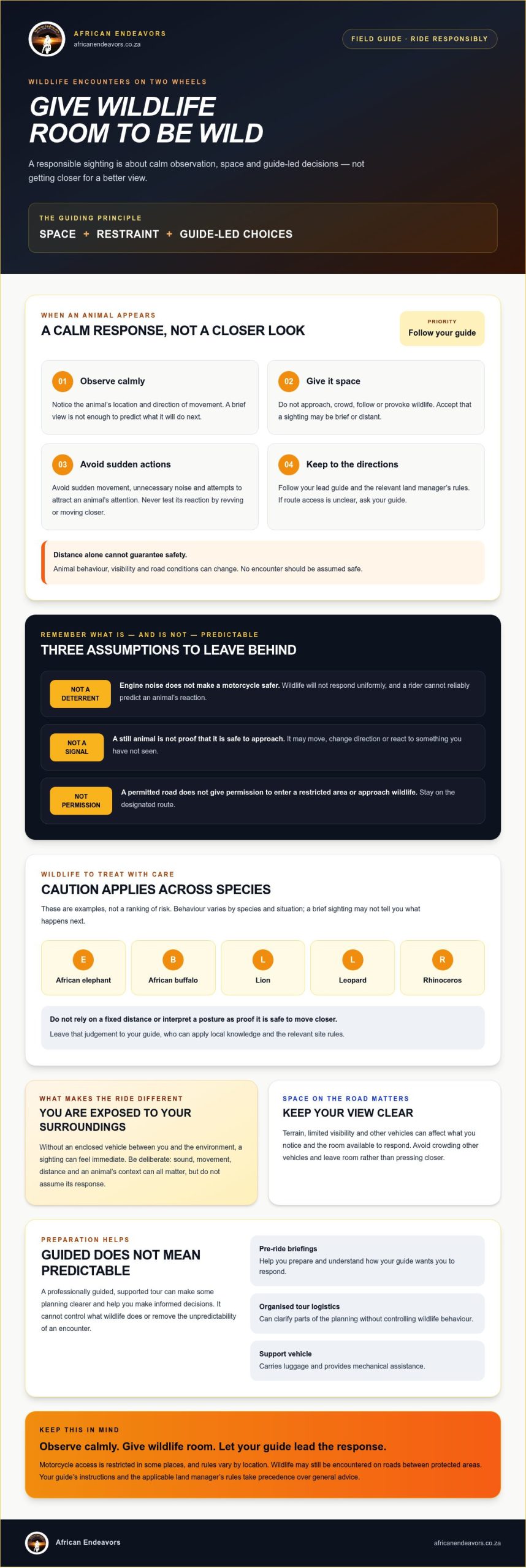
What to do when meeting wildlife on a motorcycle safari
A clear response starts before an animal appears. The steps below are general guidance, not a replacement for your tour briefing. Your lead guide’s instructions and the applicable rules of the park, reserve or land manager always take priority. If they differ from general advice, follow them.
Before setting off: prepare for a wildlife sighting
Use the briefing to understand how your group communicates and responds. Ask questions before the ride, when there’s time to clarify rather than guess.
- Confirm the guide’s signals, the group’s stopping procedure and what to do if you become separated.
- Check that any communication equipment and protective gear are ready as directed by the tour team.
- Ask how the group will respond if visibility, road conditions or wildlife presence changes.
Knowing the plan won’t make an encounter predictable, but it can help you avoid a rushed decision. Don’t assume that another rider’s actions or a previous sighting tell you what to do next.
During and after an encounter: follow the guide
If wildlife appears, stay with the group and take direction from the lead guide. Don’t stop independently for a photograph or make a sudden move to improve your view. Never approach, feed, surround or chase an animal, and don’t block its path. Keep clear of the animal and leave room for the guide and other riders to act as instructed.
- Observe and listen. Note the guide’s instructions and avoid sudden, self-directed movements.
- Respond as briefed. Slow down, stop or move only as directed by the guide and in line with local rules.
- Give the animal space. Don’t crowd it, try to influence its movement or obstruct its way forward.
- Wait for the all-clear. Report any concern to the guide and don’t resume riding until instructed.
Slow down only as directed, create space and let the guide lead. That’s a useful summary, not a substitute for the instructions given on your particular tour. If you’re unsure what a signal means, ask during the briefing rather than trying to interpret it in the moment.
On a guided ride, the briefing helps you prepare to respond thoughtfully, while organised tour logistics can reduce some uncertainty around the journey. To explore professionally guided motorcycle safari options and discuss how the tour is organised, enquire about a guided motorcycle safari.
How a guided motorcycle safari helps you prepare for wildlife
A professional guide can turn uncertainty into a clearer plan. Pre-ride briefings, route knowledge and organised logistics help you understand how to respond if wildlife affects the ride, but they can’t control animal behaviour or remove risk. A guided safari is valuable not because every moment is predictable, but because you have someone to follow when decisions matter.
Ask questions before booking so you can judge whether the tour’s pace, communication and support suit your riding experience.
Questions to ask a guided tour operator before booking
- How are wildlife briefings delivered, and how should riders communicate with the guide during a ride?
- What signals and group procedures should riders expect if the route or conditions change?
- What does the package include, and what should each rider organise or be responsible for?
- How can you discuss your riding experience and comfort around wildlife when considering an itinerary?
Clear answers help you understand what support is available and what remains your responsibility. Be candid about your experience, mobility or concerns. That gives the operator a better basis for discussing whether the route style and riding demands feel appropriate, without treating a guided tour as a guarantee of safety.
Choosing a safari that matches your confidence and priorities
Consider the kind of riding you enjoy, the level of guidance you want, and the accommodation and logistics that matter to you. Ask how the itinerary is organised and how the group receives instructions on the road. When dealing with wildlife on a motorcycle safari, confidence comes partly from knowing how decisions are communicated, not from expecting wildlife encounters to follow a script.
African Endeavors offers professionally guided, multi-day motorcycle safari tours that include motorcycle hire, fuel, accommodation and logistics. A support vehicle carries luggage and provides mechanical assistance during the tour. Riders can also ask about different riding styles, including adventure bike, Harley Davidson and off-road dirt bike tours. These arrangements can ease some of the planning burden, while the guide’s instructions help riders make informed choices on the journey.
To discuss a tour that fits your interests and riding experience, explore bespoke motorcycle safari planning and ask African Endeavors about its guided tour options.
Ride prepared, observe with respect
Dealing with wildlife on a motorcycle safari comes down to patience, space and sound judgement. Animals don’t behave predictably, so don’t approach, crowd or try to influence them. Observe from a respectful distance, and follow your guide’s instructions and the rules of the relevant land manager.
A professionally guided tour can help you prepare through briefings, clear direction and organised logistics, without removing the uncertainty of being in a wild environment. African Endeavors’ multi-day motorcycle safari packages are led by professional guides and include motorcycle hire, fuel, accommodation and logistics. A support vehicle carries luggage and provides mechanical assistance during tours.
For help planning a guided motorcycle safari, explore African Endeavors’ tours. Ride thoughtfully, give wildlife room and enjoy the freedom of the road with considered preparation.
Frequently Asked Questions
Is it safe to ride a motorcycle near wild animals on safari?
There’s no guarantee that riding near wildlife is risk-free. Safety depends on permitted routes, preparation, rider behaviour and following the guide’s instructions. Animals and road conditions remain unpredictable. Motorcycle access rules vary by site, and some parks prohibit motorcycle access, so check the relevant park, reserve or land manager’s current requirements. A professionally guided ride can help you make informed decisions, but it can’t control animal behaviour or remove all risk.
What should I do if I see an elephant while riding a motorcycle?
Stay calm and follow your lead guide’s instructions. Don’t approach, follow, surround or try to influence the elephant’s movement, and don’t assume it will respond predictably to a motorcycle. Avoid making independent moves for a closer view or photograph. If the elephant affects the route, wait for the guide to direct the group’s response. General advice can’t replace the briefing or the rules of the land manager.
Can motorcycle noise disturb wildlife during a safari?
You can’t assume engine noise will have the same effect on every animal or in every situation. Don’t rev the engine to attract attention, frighten an animal or make it move, and don’t treat noise as protection. If wildlife is near the route, follow your guide’s directions about whether to stop, restart or move. Respectful riding helps avoid unnecessary disturbance, while leaving decisions to the guide avoids testing an animal’s reaction.
How close can you get to wildlife on a motorcycle safari?
There isn’t one safe distance that applies to every species, encounter or location. Follow the guide’s directions and any rules set by the relevant park, reserve or land manager. Observe without approaching, crowding or provoking animals, and never move closer just to improve a photograph. If you’re unsure whether your position is appropriate, ask your guide rather than relying on a fixed distance or trying to interpret the animal’s behaviour yourself.
What happens if wildlife blocks the route during a motorcycle safari?
If an animal blocks the route, don’t attempt to pass it, move it or ride around it without the guide’s direction. Stay with the group, keep clear and wait for instructions. The guide can decide how the group should respond according to the situation and local rules. Don’t assume the animal will move on a particular timetable. If visibility or road conditions change as you wait, alert the guide and follow their directions.
Do guided motorcycle safaris guarantee wildlife sightings?
No. A guided motorcycle safari can offer professional guidance, briefings and organised logistics, but wildlife sightings can’t be guaranteed. Animals move freely and may not be visible along a route. African Endeavors’ multi-day packages include professional guides, motorcycle hire, fuel, accommodation and logistics, with a support vehicle for luggage and mechanical assistance. These arrangements can help riders prepare for the journey, but they don’t control wildlife or promise encounters.
Should I take photographs during a wildlife encounter on a motorcycle?
Only if your guide says it’s appropriate and you can do so without approaching, delaying the group or compromising your riding. Don’t stop independently or handle a camera while moving. Follow the briefing about where and when riders may stop, and keep your attention on the guide’s instructions and surroundings. If taking a photograph would mean crowding wildlife or obstructing the group, leave the camera alone and observe from where you are.
