
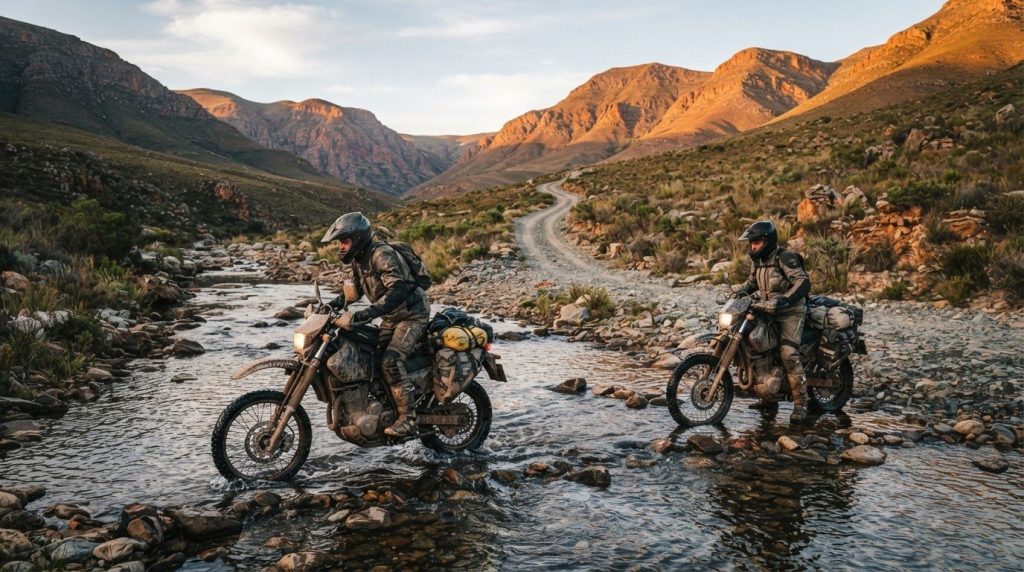
This is a route that demands attention, not just admiration. A Baviaanskloof motorcycle tour guide should prepare riders for challenging descents, rough road sections and river crossings. The planned ride covers 1,100 km over four days, mostly on dirt roads.
The appeal is clear: remote Eastern Cape scenery, rugged surfaces and river crossings make the journey a genuine adventure. But knowing what lies ahead matters as much as the thrill, especially when comparing the route with your riding experience and the support you want along the way.
This guide covers the route and crossings, trip duration and distance, and what to expect from gravel and tar. It also explains how to assess accommodation and support arrangements, so you can picture the riding days and understand what a guided tour adds to a remote journey.
Key Takeaways
- Understand how the Baviaanskloof route’s remote terrain and river crossings shape the demands of the ride.
- Use the itinerary’s overall distance and riding days to gauge how the journey fits your plans.
- Learn what gravel and tar sections mean for preparation and the riding experience.
- Compare guided-tour support, luggage arrangements and accommodation considerations before choosing your adventure.
Baviaanskloof Pass route and river crossings
The Baviaanskloof route combines remote mountain terrain with demanding water crossings. A Baviaanskloof motorcycle tour guide can explain the route’s main challenges and help riders prepare for changing surfaces.
Adventure route and river crossings
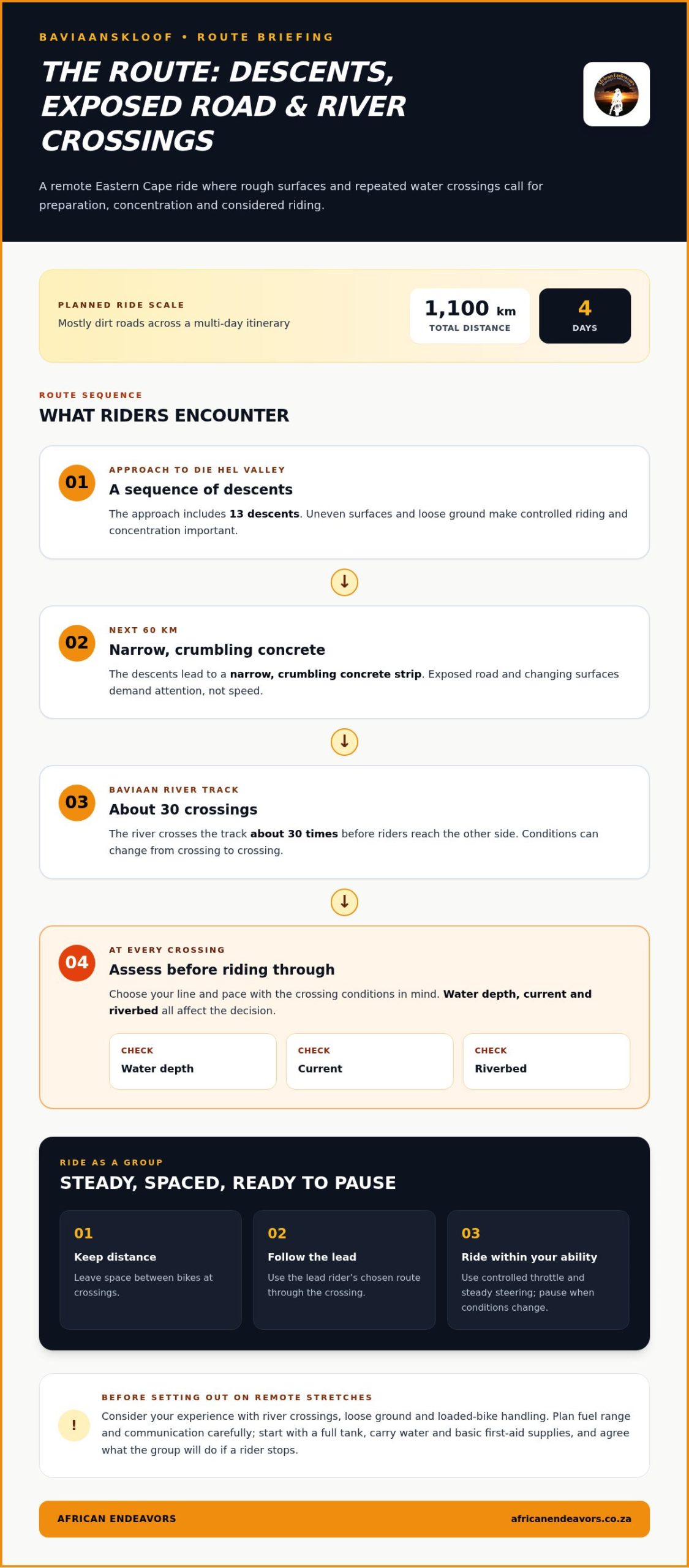
The approach to Die Hel valley includes 13 descents, followed by a narrow, crumbling concrete strip for the next 60 km. The Baviaan River crosses the track about 30 times before riders reach the other side. Assess each crossing before riding through: water depth, current and the riverbed affect the line and pace. Keep distance between bikes, and follow the lead rider’s chosen route.
Rider experience and route difficulty
This route suits riders confident handling an adventure motorcycle on uneven surfaces and loose ground. Repeated crossings call for controlled throttle, steady steering and the judgement to pause when conditions change. Descents and exposed concrete demand concentration, not speed. Before setting out, consider your experience with river crossings, loaded-bike handling and long stretches away from busy roads.
For regional context, the Baviaanskloof valley spans nearly 200 kilometres. The Garden Route offers a different touring backdrop, whilst the Seweweekskloof Gorge route includes 23 river crossings. Swartberg Pass is another mountain-road comparison: its gravel section runs 14 km between Calitzdorp and Van Wyksdorp.
When comparing tour reviews, look for specific details about route guidance, support vehicles, luggage handling and accommodation rather than relying on star ratings alone. A review describing a guided crossing offers more practical insight than a general compliment.
Do riders need permits or follow specific rules? Access requirements can depend on the route and land crossed, so follow posted instructions and your guide’s directions. Stay on the established track and respect closures.
What is the best season and weather? Choose dates with the forecast and river conditions in mind. Rain can change crossing conditions, whilst heat affects comfort and hydration.
On remote stretches, plan fuel range and communication carefully. Start with a full tank, carry water and basic first-aid supplies, and agree on what the group will do if a rider stops.
Choose a guided itinerary that matches your off-road experience, then book directly with the tour operator. Bring protective riding gear, suitable footwear, water and personal essentials for the day.
Tour duration and total distance
The planned motorcycle ride covers 1,100 km over four days, mostly on dirt roads. That gives the journey a clear overall scale, but distance alone doesn’t show how each riding day will feel. Surface changes, river crossings, stops and the route’s remoteness all affect the time spent riding.
One recorded approach covered 140 km before dropping down to Patensie and the southern end of the Baviaanskloof. Use Patensie as a useful route marker, not as a guide to the full journey’s daily distance. The actual day-by-day breakdown depends on the itinerary, including where it starts, where it finishes and which roads it follows.
A four-day motorcycle trip calls for more than calculating distance. Consider the sequence of stages: a demanding dirt-road day followed by another long ride can feel very different from a route with varied terrain and planned pauses. Find out how the itinerary handles slower sections, sightseeing stops and accommodation between riding days. These details help you judge whether the pace fits your experience and travel plans.
Before departure, map each stage against the day’s destination and connecting roads. Allow time for fuel stops, meals and breaks instead of treating the map’s riding distance as the whole day. On dirt, surface conditions and rider pace can change the rhythm, so a practical schedule leaves room for the route itself.
Use the four-day plan to organise leave, arrival and departure arrangements, then check that the full itinerary fits those dates. If you’re comparing guided rides across South Africa, explore the motorcycle tour itineraries alongside their routes and riding durations.
Gravel and tar riding
Surface changes shape the riding experience across the Eastern Cape. On gravel, loose stones, corrugations and changing traction call for smooth inputs and a measured pace. Tar offers firmer grip, but bends, gradients and transitions still demand attention. Treat the surface as part of your preparation, not a minor itinerary detail.
The Baviaanskloof combines dirt roads with sections that call for careful line choice. On gravel, look ahead for softer edges, ridges and loose material. Keep your movements calm, avoid abrupt braking and leave room to adjust your line. On tar, settle into a steady rhythm and moderate your speed before the surface changes again.
Rooiberg Pass offers a useful regional example of gravel mountain riding. Its 14 km route connects Calitzdorp to Van Wyksdorp, with the climb and descent making surface awareness essential. A gravel pass feels different from a fast dirt road: corners, gradients and visibility influence how much control you need at each point.
Before departure, match your motorcycle setup and riding approach to the itinerary. Check tyre condition and pressure, secure your luggage, and consider which controls you’ll need on loose ground. Find out how much of each stage is gravel or tar and whether the route includes rough or narrow sections. These details help you assess the day’s demands without treating all dirt roads alike.
Rider technique matters on both surfaces. Stand on the footrests when uneven gravel calls for a relaxed posture, and keep your gaze on the path ahead. On tar, use a smooth throttle and brake before corners rather than mid-turn. Follow the guide’s pace and spacing, especially where the road surface changes unexpectedly.
A route description should make surface transitions clear, helping you prepare mentally and practically. For the Baviaanskloof, consider your confidence on loose gravel, experience with mountain roads and comfort managing a loaded motorcycle. These factors help you decide whether the mix of riding suits your skills.
Which motorcycle tour guides operate in the Baviaanskloof, South Africa?
Choosing a Baviaanskloof motorcycle tour guide means comparing the route, support and riding style, not just the name on an itinerary. The Baviaanskloof has remote dirt roads and repeated river crossings, so look for a guided ride with a clear route description and practical arrangements. A detailed itinerary helps you judge whether the experience suits your skills and travel plans.
Reviews can help you assess a tour, but focus on useful details rather than star ratings alone. Look for accounts describing route briefings, changing surfaces, group pace and unexpected delays. A review explaining how riders were briefed before a river crossing offers more insight than a general comment about scenery. Compare recent reviews with the published itinerary and support information.
Use these points to compare guided options:
- Route detail: Check whether the itinerary identifies the Baviaanskloof section and describes its riding surfaces.
- Rider fit: Look for a clear explanation of the off-road experience needed and the expected pace.
- Tour logistics: Review how luggage, accommodation, meals and support vehicle arrangements are described.
These criteria distinguish a guided adventure from a simple route outline. The day’s plan should be clear, including where riders regroup and how the itinerary accommodates demanding sections. Consider whether the description addresses your main concern, such as riding gravel confidently or managing a long day in the saddle. This is more useful than choosing by headline alone.
Some South African motorcycle tours focus on other regions rather than the Baviaanskloof itself. Match the destination to your priority: remote dirt riding, scenic touring or a broader multi-region journey. If you’re considering professionally guided motorcycle travel in South Africa, explore guided motorcycle tour options and compare their routes with the kind of riding you want.
African Endeavors: The Wild Coast & Drakensberg Tour
If you’re open to exploring beyond the Baviaanskloof, consider African Endeavors’ The Wild Coast & Drakensberg Tour. This guided motorcycle adventure offers another way to experience South Africa’s varied landscapes, with the journey centred on riding rather than planning every detail yourself.
Choose this next step if you want a professionally guided tour and are comparing regions, not only looking for a Baviaanskloof itinerary. African Endeavors also offers The Kruger Park & Panorama Route Tour, The Garden Route & Route 62 Tour and Off-Road Dirt Bike Safaris. Each gives you a distinct direction for a South African motorcycle journey.
To discuss a guided ride that suits your travel plans, contact African Endeavors.
Choose the ride that calls you next
Choose your next ride based on the journey you want, not just the destination on a map. A Baviaanskloof motorcycle tour guide may suit a rider seeking a remote off-road challenge; another South African route may better match your preferred pace, scenery or riding style.
African Endeavors offers The Wild Coast & Drakensberg Tour, The Kruger Park & Panorama Route Tour, and The Garden Route & Route 62 Tour. Each gives you another region to consider as you shape your next motorcycle adventure. Think about whether you’re drawn to mountain roads, coastal landscapes or a journey through changing terrain, then explore the itinerary that best fits your plans.
For a conversation about a guided tour, contact African Endeavors about your tour. Your next South African ride could begin with a clear choice of route and a sense of adventure.
Frequently Asked Questions
What guided Baviaanskloof motorcycle tour routes and itineraries are available?
Routes may take riders through the Baviaanskloof towards Die Hel valley or approach the southern end near Patensie. The itinerary depends on its start and finish points and whether it includes neighbouring passes or regional roads. Compare the route map and overnight stops to see what each guided option covers rather than assuming every tour follows the same circuit.
How long are Baviaanskloof motorcycle tours, and what distance do they cover?
The planned ride described for this route covers 1,100 km over four days, mostly on dirt roads. A section of 140 km leads towards Patensie and the southern end of the Baviaanskloof. Treat those figures as a route plan, not a standard duration for every tour. The itinerary’s start point, finish point and chosen roads determine its overall distance.
Which motorcycle types and rider skill levels are suitable for Baviaanskloof tours?
Adventure motorcycles and off-road dirt bikes suit routes with loose surfaces and water crossings. The best choice depends on the itinerary and your control at low speeds. African Endeavors offers Adventure Bike Tours, Off-Road Dirt Bike Safaris and Harley Tours. For Baviaanskloof terrain, prioritise gravel experience, balance on uneven ground and confident braking over outright speed.
What are the Baviaanskloof road conditions and difficulty for motorcycles?
Expect mixed conditions, including gravel, narrow damaged concrete and river crossings. This route calls for attentive off-road riding, and difficulty can change with traction, visibility and crossing conditions. Riders should be comfortable adjusting their line and pace, stopping to assess a section and following the guide’s instructions when terrain changes. A steady, controlled approach matters more than speed.
What is the best season and weather for a Baviaanskloof motorcycle tour?
Choose dates with the forecast and river conditions in mind. Rain can change crossing conditions, while heat affects comfort and hydration.
