
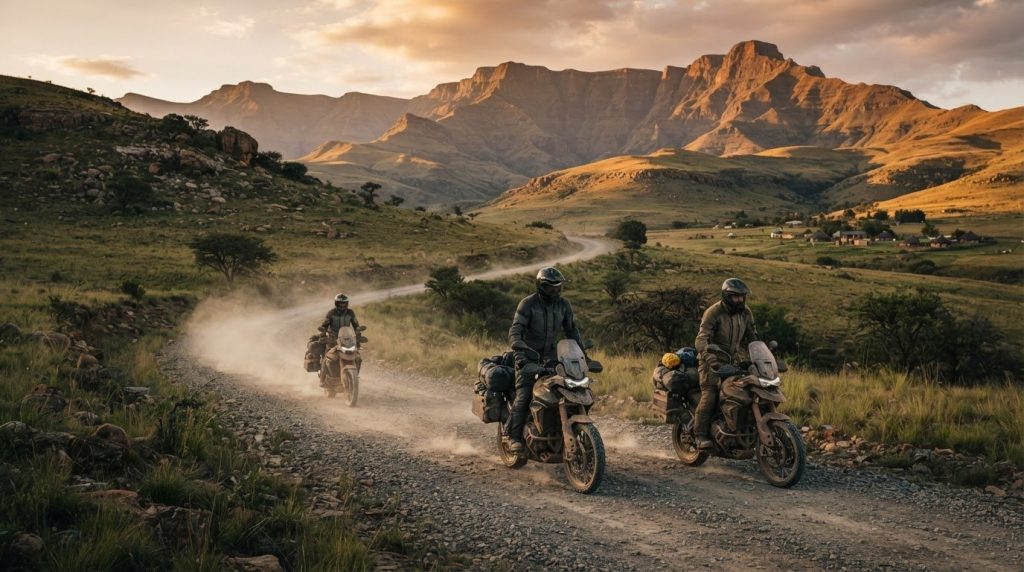
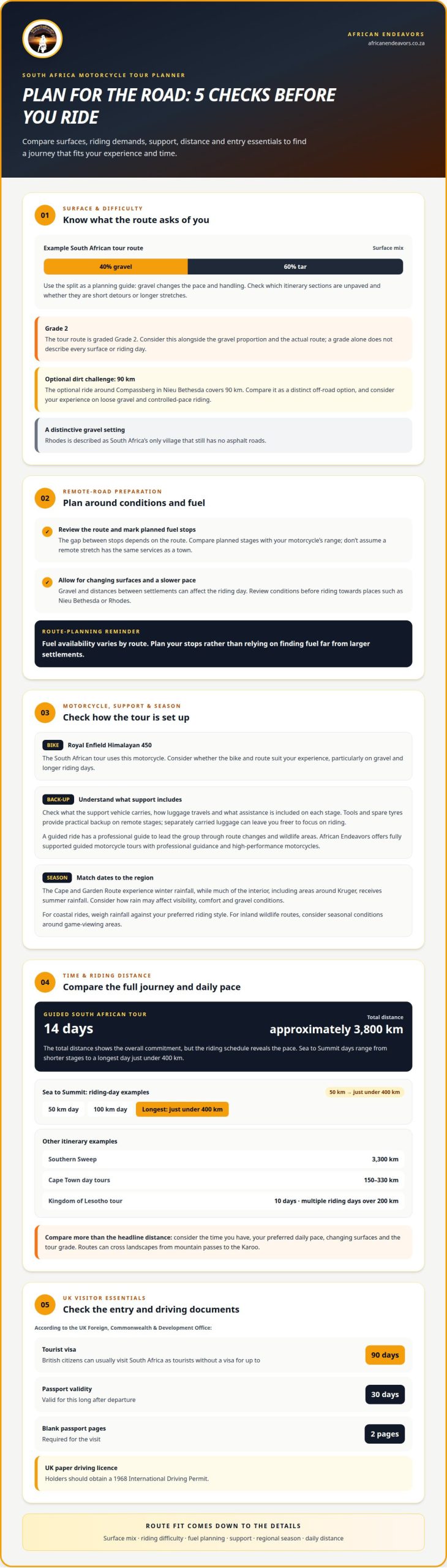
For British riders, the entry rules are clear: according to the UK Foreign, Commonwealth & Development Office, British citizens can usually visit South Africa as tourists without a visa for up to 90 days, and holders of a UK paper driving licence should obtain a 1968 International Driving Permit. The same office says visitors need a passport valid for 30 days after departure, with two blank pages. With those essentials in mind, off the beaten track motorcycle tours in South Africa open up a choice between gravel-road challenges, sweeping tar routes and days that bring both into view.
The appeal of off the beaten track motorcycle tours South Africa is easy to understand: leave the main highways behind and ride through changing landscapes, past wildlife and small settlements, with memorable stops along the way. But which tour fits your riding experience, and how much time should you allow?
This guide compares route styles, gravel riding, tour duration, accommodation, safaris and activities, along with visa and permit considerations. Use it to get a clearer sense of the journey before choosing a tour.
Key Takeaways
- Use the 40% gravel and 60% tar route split as a starting point, then consider how comfortable you are with changing surfaces and remote riding.
- Compare tour routes by the landscapes and riding style you want, and see how guide and support arrangements can shape the journey.
- Match the tour’s total distance and daily riding demands to the time you have and the pace you enjoy.
- Plan remote-road days around changing conditions and fuel stops so you can ride with greater confidence through South Africa’s quieter regions.
Gravel-road proportion and riding difficulty
South African routes can combine smooth tarmac with remote gravel, changing the pace and demands of a ride. Before choosing, compare the surfaces, riding difficulty and any off-road sections with your experience and preferred style.
Gravel and tar road mix
A South African tour route is described as 40% gravel and 60% tar. That balance gives riders stretches of sealed road alongside unpaved sections, where pace and handling feel different. Use the split as a planning guide, then consider how comfortable you are riding gravel for sustained periods. The village of Rhodes, for example, is described as South Africa’s only village that still has no asphalt roads.
For a ride with more gravel, look beyond a headline percentage. Check which itinerary sections use unpaved roads, and whether they involve short detours or longer stretches. Routes through places such as Rhodes offer a different experience from a brief gravel section, so read the route details closely.
Riding difficulty and off-road options
The South African motorcycle tour route is graded Grade 2, a useful point of comparison when judging whether its riding demands suit your experience. A grade alone doesn’t describe every surface or riding day, so consider the gravel proportion alongside the route itself. Riders seeking a dedicated dirt challenge can also look for optional off-road riding.
One example is the optional ride around Compassberg in Nieu Bethesda, which covers 90 km. Treat it as a distinct off-road option when comparing the itinerary with a mixed-surface tour. Think about your experience on loose gravel, your comfort managing a motorcycle at a controlled pace, and whether you want a day focused on dirt rather than tar.
Remote road conditions and fuel stops
On remote South African routes, road conditions and fuel planning go hand in hand. Gravel, distances between settlements and fuel availability all affect the day. The gap between fuel stops depends on the route, so compare planned stages with your motorcycle’s range. Don’t assume a remote stretch has the same services as a town.
Before riding towards places such as Nieu Bethesda or Rhodes, review the route and mark the planned fuel stops. Allow extra time for changing surfaces and a slower pace. A little preparation helps you ride quiet gravel roads with a plan, rather than relying on finding fuel far from larger settlements.
Which motorcycle tour should I choose in South Africa?
Choose by matching the motorcycle, support arrangements and route season to your riding experience. A guided journey through Kruger, for example, calls for different planning from a coastal ride.
Motorcycle choice and tour backup
The South African tour uses a Royal Enfield Himalayan 450. When comparing a motorcycle tour, consider whether its bike and route suit your experience, especially on gravel and longer riding days. Ask what the support vehicle carries and how luggage travels, as these details affect what you need to carry on the motorcycle.
Support arrangements vary by tour, so check the itinerary to understand what assistance is included and how it works on each stage. A guided ride provides a professional guide to lead the group through route changes and wildlife areas. African Endeavors offers fully supported guided motorcycle tours, with professional guidance and high-performance motorcycles.
Regional touring seasons
There isn’t one best season for every South African region. The Cape and Garden Route experience winter rainfall, while much of the interior, including areas around Kruger, receives summer rainfall. Choose dates with the route’s regional weather in mind, and consider how rain may affect visibility, comfort and gravel conditions.
For a coastal itinerary, weigh rainfall against the kind of riding you want. For an inland wildlife route, consider seasonal conditions around game-viewing areas. The right choice depends on the region and the balance you prefer between comfortable riding and seasonal scenery. Compare itineraries and regional conditions before settling on dates.
Also consider the support style you want: luggage carried separately can leave you freer to focus on the ride, while tools and spare tyres provide practical backup on remote stages. Use those details, along with the bike and regional season, to compare guided motorcycle tour options and choose a route that fits your priorities.
Tour duration, distances and riding days
South African motorcycle itineraries range from Cape Town day rides to journeys lasting several days. Compare total distance with the riding schedule, not just the number of nights away.
A guided South African tour lasts 14 days and covers approximately 3 800 kilometres. That total gives you a sense of the overall commitment, but daily stages determine the pace. The Sea to Summit itinerary includes riding days of 50 km and 100 km, as well as a longest day just under 400 km. These examples show how sharply distances can vary within one tour.
Other itineraries offer different balances. The Southern Sweep covers 3,300 km, while Cape Town day tours cover routes of 150-330 km. A 10-day Kingdom of Lesotho tour includes multiple riding days exceeding 200 km. Compare these figures with the time you have, your preferred daily pace and the type of landscapes you want to cross, from mountain passes to the Karoo.
Tour grading helps you judge suitability alongside distance. A grade describes the expected riding challenge, while the itinerary shows how long you’ll spend in the saddle and how surfaces change. Use both when assessing your experience, especially if you’re new to sustained gravel riding. Touring-grade routes can include riding days of up to 450 km, so check the longest stage rather than relying on the average.
Tour price depends on the route, duration, accommodation and whether motorcycle hire is included; the price is provided after a quote request. Separate hire costs from the tour price when comparing options, since the 14-day South African tour figure excludes motorcycle hire. Before choosing, map each day’s distance against your available holiday time, preferred pace and appetite for long stretches between stops.
What are the road conditions and fuel-stop distances on remote South African motorcycle routes?
Remote routes reward preparation, but road surfaces and services vary by region. Around the Karoo, a route may cross long, open stretches between settlements; coastal roads bring different terrain and riding conditions. Don’t plan each stage as if it were a city commute. Read the itinerary road by road, noting gravel sections, nearby towns and whether the daily distance suits your pace.
Surface conditions affect both speed and fuel planning. Loose gravel, corrugations, dust and uneven patches can call for slower, more measured riding than sealed roads. Rural routes in the Eastern Cape may pass through small settlements rather than large service centres. Keep an eye on sightlines and changing surfaces, and allow time for a careful pace. Weather and road maintenance can also change conditions.
Fuel-stop distances depend on the route, fuel-station locations and your motorcycle’s usable range. A settlement on a map doesn’t necessarily mean fuel is available. Before leaving a larger centre, identify the next planned refuelling point and compare its distance with your bike’s range and the day’s route. Focus on the longest gap between reliable stops, not just the total distance.
For a practical plan, mark each fuel stop on the day’s route, note the distance between stops, then refuel at the planned points rather than waiting for a low tank. Keep navigation available through remote areas where services are sparse, and carry water for exposed stretches. On a guided ride, route planning can account for the day’s terrain and stops. Explore guided South African motorcycle routes to compare journeys through quieter regions.
African Endeavors: The Wild Coast & Drakensberg Tour
African Endeavors’ Wild Coast and Drakensberg tour offers a guided way to explore two distinctive South African regions. It suits riders who want a planned motorcycle journey rather than arranging each stage independently, with coastal and mountain scenery shaping the experience.
For a different journey, compare The Kruger Park & Panorama Route Tour or The Garden Route & Route 62 Tour. Riders seeking a dirt-focused experience can consider Off-Road Dirt Bike Safaris. Think about the landscapes, riding style and level of off-road challenge you want before choosing. Each option offers a different way to experience South Africa by motorcycle.
Visit africanendeavors.co.za to explore the tours and contact African Endeavors about your preferred journey.
Choose the road that calls you
The best journey is the one that matches the kind of experience you want to carry home. Choose the landscapes and riding style that speak to you, then turn that preference into a route worth anticipating. For riders drawn to off the beaten track motorcycle tours in South Africa, African Endeavors offers The Wild Coast & Drakensberg Tour, The Kruger Park & Panorama Route Tour, and The Garden Route & Route 62 Tour. Each gives you a distinct starting point for imagining your next adventure, from mountain horizons to coast roads and wildlife country.
Take the next step by sharing the kind of ride you have in mind. Contact African Endeavors about your ride and begin shaping a South African journey that feels distinctly yours.
Frequently Asked Questions
Do I need a visa or an International Driving Permit to ride in South Africa?
British citizens can usually visit South Africa without a tourist visa for up to 90 days, according to the UK Foreign, Commonwealth & Development Office. It also advises holders of UK paper driving licences to obtain a 1968 International Driving Permit for riding. Carry the permit alongside your driving licence, and make sure your travel documents meet South Africa’s entry requirements before departure.
What are the best off-the-beaten-track motorcycle tours in South Africa?
The best choice depends on the landscape and riding style you want. For coastal roads and mountain scenery, consider The Wild Coast & Drakensberg Tour; for a wildlife-focused journey, look at The Kruger Park & Panorama Route Tour. The Garden Route & Route 62 Tour offers another regional option, while Off-Road Dirt Bike Safaris suit riders seeking a more dirt-focused experience.
Which South African regions offer scenic remote motorcycle routes beyond the main tourist roads?
The Wild Coast and Drakensberg offer a striking mix of coastline and mountain country. The Karoo brings wide, open landscapes, while routes around Kruger and the Panorama Route combine dramatic scenery with wildlife experiences. For a coastal journey, the Garden Route and Route 62 provide another option. Compare the regions by terrain and the kind of stops you want along the way.
What are typical prices for guided and self-guided motorcycle tours in South Africa?
There is no single typical price for motorcycle tours across South Africa. Route, duration, accommodation and motorcycle hire all affect the cost. African Endeavors offers guided tours, not self-guided motorcycle rentals, so compare guided itineraries by what each package covers rather than treating them as equivalent to self-guided hire.
Which motorcycle tour companies in South Africa specialise in small-group or adventure routes?
African Endeavors offers guided adventure routes in South Africa, including Adventure Bike Tours, Harley Tours and Dirt Bike Tours. Each suits a different riding style, from scenic road journeys to off-road experiences. If group size matters to your decision, review the tour format and itinerary to see whether the experience suits your plans.
What motorcycles, riding gear and support services are included in South African tours?
Included equipment and support depend on the tour package. African Endeavors’ guided tours provide high-performance motorcycles and professional guidance, and are described as fully supported. Don’t assume personal protective gear is supplied: plan your helmet, gloves, boots and weather-appropriate layers separately unless your tour details state otherwise. Match your gear to the route’s road surfaces and changing conditions.
