
The biggest engine isn’t automatically the best touring choice. For comfortable adventure motorcycle touring, balance riding position, fuel range, luggage load and the kind of roads you’ll ride with the engine’s size and power. Bikes in the 300 to 500 cc range are lighter and fuel-efficient, whilst 600 to 900 cc models offer a middle ground for highway riding, moderate off-road routes and carrying gear.
A long ride should leave you free to enjoy South Africa’s changing landscapes, not distracted by a motorcycle that doesn’t suit your pace or plans. This guide explains how fuel capacity affects touring range, why road-focused and off-road-focused bikes feel different, and how price, engine size and power can shape your choice. You’ll have a clearer way to weigh the practical trade-offs before setting out.
Key Takeaways
- Compare fuel-tank capacity alongside your route and luggage, rather than treating capacity alone as a promise of touring range.
- Choose a road- or off-road-focused set-up to suit the terrain you expect to ride and the load you plan to carry.
- Build your budget around the bike’s purchase price and the touring preparation it needs, including luggage and other essentials.
- Match engine size and power to your balance of highway riding, off-road routes and carrying gear.
1. Fuel tank capacity and touring range
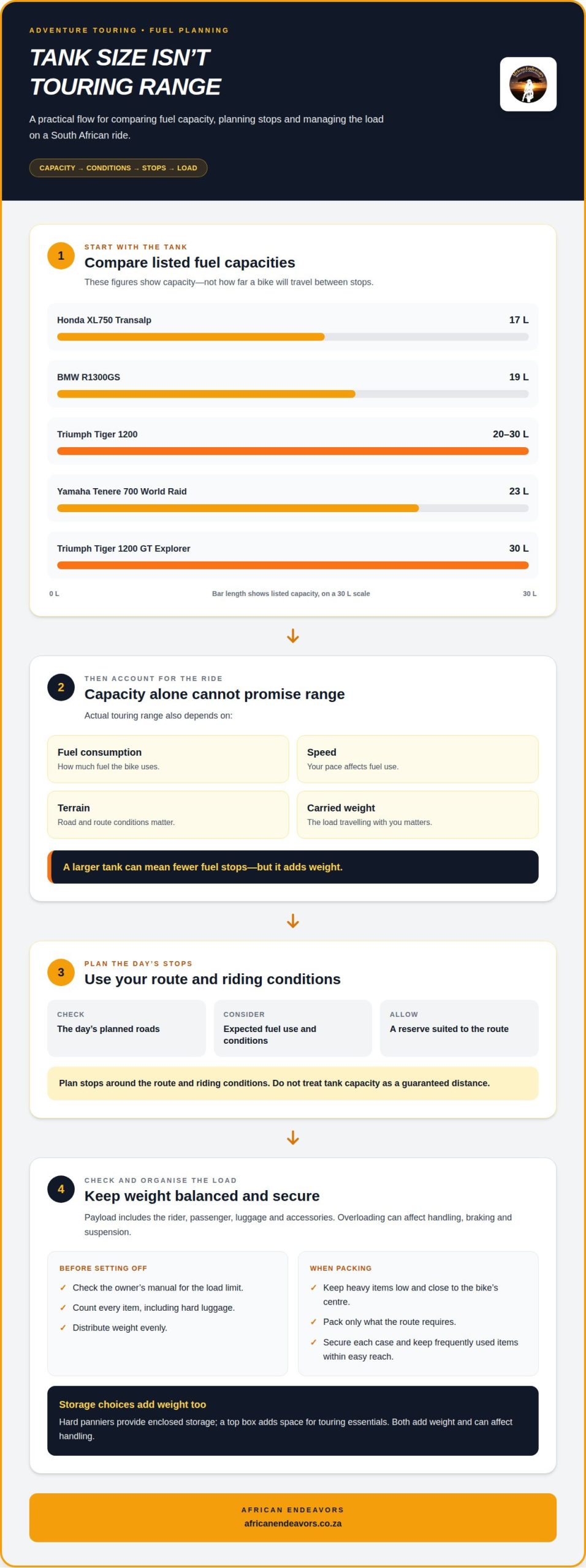
Fuel capacity affects how you plan long South African rides, but tank size alone can’t tell you the distance between stops. The Honda XL750 Transalp has a 17 L tank, the BMW R1300GS holds 19 L, and the Yamaha Tenere 700 World Raid has a 23-litre tank. The Triumph Tiger 1200 has a listed capacity range of 20-30 L, while the Tiger 1200 GT Explorer has a 30-litre tank.
Actual touring range also depends on fuel consumption, speed, terrain and carried weight. A larger tank can mean fewer fuel stops, but it adds weight; plan stops around your route and riding conditions instead of treating capacity as a guaranteed distance. Compare the day’s planned roads with expected fuel use before deciding how much reserve to allow.
Payload includes the rider, passenger, luggage and accessories. Overloading a motorcycle can affect handling, braking and suspension, so distribute weight evenly and keep heavy items low and close to the bike’s centre. Before setting off, check the owner’s manual for the load limit and count every item, including hard luggage.
Hard panniers provide enclosed storage, while a top box adds space for touring essentials. Both add weight and can affect handling. Pack only what the route requires, secure each case, and keep frequently used items within easy reach. A well-adjusted windscreen can redirect airflow, while suitable luggage helps keep equipment stable and organised.
An upright riding position can reduce strain on your wrists, back and knees over long distances. Adjust the handlebars to suit your reach, keeping your shoulders relaxed and wrists at a comfortable angle. Check your position while seated with both feet on the ground. These ergonomic details, along with sensible load management, help make comfortable adventure motorcycle touring more sustainable throughout the day.
2. Road-focused and off-road-focused variants
Adventure bikes bridge sealed roads and rough tracks, while sport-tourers prioritise responsive road handling and touring motorcycles often favour relaxed, sheltered cruising. To assess comfort, compare riding position, wind protection and suspension with your actual route instead of assuming one category suits every South African journey.
Road-oriented adventure motorcycles suit long stretches of tar, gravel connectors and occasional uneven ground. Their road-biased tyres and suspension can feel composed through bends, while an upright position gives riders a clear view of changing surfaces. If your route is mostly tar with a few gravel detours, this balance may be more useful than a highly specialised off-road set-up.
For rougher tracks, long-travel suspension helps absorb uneven terrain and provides ground clearance. Adjustable suspension can be adapted to different loads and riding styles, including luggage or riding with a passenger. Set it for the expected load before departure: a set-up that feels comfortable unladen may behave differently once packed.
Seat height and shape affect how easily you reach the ground at stops, while cushioning and width influence comfort over a long day. The Honda NX500 has an 830 mm seat height, the Triumph Tiger Sport 800 is 835 mm, and the Yamaha Tenere 700 World Raid is 890 mm. Other examples include the Triumph Tiger 900 Rally Pro at 820-840 mm, the Tiger 1200 at 850-870 mm, and the KTM 890 Adventure R at 880 mm. These figures help narrow choices, but seat shape also affects reach.
There’s no single best adventure motorcycle for South Africa: a road-focused model suits tar-heavy touring, whilst a more dirt-oriented bike better fits frequent rough routes. Test the seat reach and suspension feel for your build and intended terrain. The European Commission notes that riders remain relatively unprotected even when wearing personal protective equipment, so prepare by wearing suitable protective gear, planning routes and considering changing surfaces. For a road-led scenic ride, Harley Davidson Scenic Tours offer a guided alternative to choosing an adventure bike.
3. Touring motorcycle prices and budgets
There’s no single South African price for a comfortable touring motorcycle. The amount depends on the model, age, condition and equipment. A new adventure bike and a used example of the same model can differ substantially in value. Mileage, service history, damage, modifications and included luggage also affect a used motorcycle’s asking price, so compare like with like.
Build your budget around the complete motorcycle, not just its advertised price. List the equipment your routes require, such as hard luggage, protective accessories or touring-focused comfort upgrades, then account for any work needed after purchase. An older bike with a lower asking price, for example, may need maintenance before a long-distance trip, while a better-equipped model may already suit your plans.
Engine size and intended use help narrow your options. A lightweight adventure motorcycle designed for simpler touring needs may require different equipment from a larger model intended for highway journeys or substantial luggage. Compare features that matter for your route, including wind protection, suspension, storage and passenger comfort. Avoid paying extra for equipment that won’t improve your planned ride.
For a practical comparison, shortlist motorcycles with similar age, condition and touring equipment. Record each asking price alongside its service history, luggage, accessories and likely preparation needs. Compare the total with your budget, leaving room for essentials such as riding gear and route-related expenses. This makes the trade-offs clear: a lower purchase price may not mean lower overall spending, and the most expensive option may include features you don’t need.
South African motorcycle prices vary with supply, demand and each bike’s condition, so use current local listings rather than overseas prices for comparison. The key question is how much the motorcycle will cost to prepare for your distance and riding style. A clear budget helps you choose a capable touring machine without mistaking premium specifications for the best value for your journey.
4. Adventure motorcycle engine size and power
Engine capacity helps indicate how an adventure motorcycle may suit your travel, but it isn’t the only measure of comfort. Bikes from 300cc to 500cc are described as lightweight and fuel-efficient, yet may lack power for long highway stretches or heavy luggage. For shorter journeys and lighter loads, that trade-off can make sense; extended South African distances may call for more performance.
The 600cc to 900cc class offers a balance between power and weight for highway speeds, moderate off-road riding and carrying gear. For example, the Honda NX500 has a stated output of 47 hp, while the Honda XL750 Transalp produces 91 bhp, also expressed as 92 PS. These examples show why engine size alone doesn’t describe how a motorcycle delivers power. Compare the output with your expected load and the roads you’ll ride.
At 1000cc and above, adventure motorcycles are described as suited to highway cruising, high-altitude riding and two-up touring. Their extra weight and size can become a drawback off-road, particularly on gravel where riders need to manage balance and direction through changing surfaces. More capacity can help with demanding touring conditions, but it doesn’t automatically make a motorcycle easier or more comfortable to handle.
Before choosing, match the engine class to your journey. Consider how often you’ll ride at highway speeds, whether you’ll carry a passenger or luggage, and how much of the route includes gravel. Then assess weight and power together: a powerful engine may feel reassuring on open roads, while a lighter bike can be easier to manage on rougher ground. The right choice suits your route, load and confidence, not simply the largest engine.
Ready to put your choice into the landscape? Explore guided motorcycle tours in South Africa.
African Endeavors: The Wild Coast & Drakensberg Tour
The Wild Coast & Drakensberg Tour offers a guided way to experience South Africa’s dramatic coastal and mountain landscapes from the saddle. Choose this kind of journey if you want the freedom of motorcycle travel without planning every route and riding day yourself. African Endeavors runs fully supported motorcycle safaris, combining open roads and changing scenery with the practical structure of a guided tour.
If your ideal trip centres on another landscape, the Kruger Park & Panorama Route Tour and the Garden Route & Route 62 Tour offer further guided touring options, while Off-Road Dirt Bike Safaris focus on off-road riding. Each suits a different kind of adventure, so consider the terrain and riding experience you want before choosing.
For a guided South African motorcycle journey, contact African Endeavors to discuss your plans.
Choose the journey that calls you
The next decision isn’t simply which motorcycle looks right on paper. Consider what you want your days on the road to feel like: sweeping coastal views, mountain air, or a route that blends changing landscapes with time in the saddle. Let that vision guide your choice, and comfortable adventure motorcycle touring becomes less about chasing a perfect specification and more about finding the right fit for your travel style.
A guided tour brings the route, riding and scenery together, so you can focus on the experience instead of organising every detail yourself. Think about the landscapes you’re drawn to and the kind of adventure you want, then take the next step towards planning it with African Endeavors.
Contact African Endeavors to plan your tour, and start shaping a South African ride that gives you something to look forward to.
Frequently Asked Questions
What makes an adventure motorcycle comfortable for long-distance touring?
A comfortable touring bike lets you maintain a relaxed posture and reach the controls naturally. Check that the seat supports you evenly, your knees aren’t cramped, and the screen doesn’t direct turbulent air at your helmet. Sit on the motorcycle in your usual riding gear and hold the position for several minutes. Notice any pressure points and make sure you can operate the controls smoothly.
What are the fuel range, fuel consumption, and tank capacity of popular touring adventure bikes?
Fuel range varies with consumption and riding conditions, so tank capacity alone can’t provide a reliable distance. To estimate range, divide usable fuel by expected consumption, then plan stops conservatively for your South African route. Consumption changes with speed, terrain and load. Use figures from comparable riding conditions rather than relying on a best-case estimate from gentle, unladen riding.
What tyres and suspension setup work best for South African adventure touring roads?
Choose tyres to suit the surfaces that dominate your route: a road-focused pattern favours sealed tarmac, while a versatile tread suits journeys mixing tar and gravel. Set tyre pressures according to the motorcycle and tyre manufacturers’ guidance, and inspect tread and damage before departure. Start suspension adjustments with the manufacturer’s recommended settings, then assess handling on a short, familiar ride before travelling farther.
