
The right motorcycle safari is planned around the ride as well as the wildlife. Seeing the Big Five from a motorcycle in South Africa means choosing a route that suits your journey and preparing for the practical demands. Fuel range, touring comfort and well-chosen equipment all shape how each day on the road feels.
Riding through South Africa’s wide-open landscapes is part of the appeal, but long days in the saddle call for more than a powerful engine. Consider how far the motorcycle can travel between fuel stops, what will keep you comfortable on a full day’s ride and which equipment will help you stay prepared.
This guide covers the essentials: how to think about fuel range and consumption, how comfort affects touring and what to pack for a motorcycle safari. With these details in mind, you can plan the ride with greater confidence and focus on the road, the landscape and the wildlife beyond it.
Key Takeaways
- Assess comfort, luggage and equipment alongside fuel range to prepare for long days on South African roads.
- Learn how to plan wildlife viewing around the motorcycle access available at national parks and reserves.
- Separate scenic motorcycle routes from safari areas, then shape an itinerary around both riding and wildlife experiences.
- Explore guided touring options that connect South Africa’s landscapes with a more structured motorcycle adventure.
2. Touring comfort and equipment
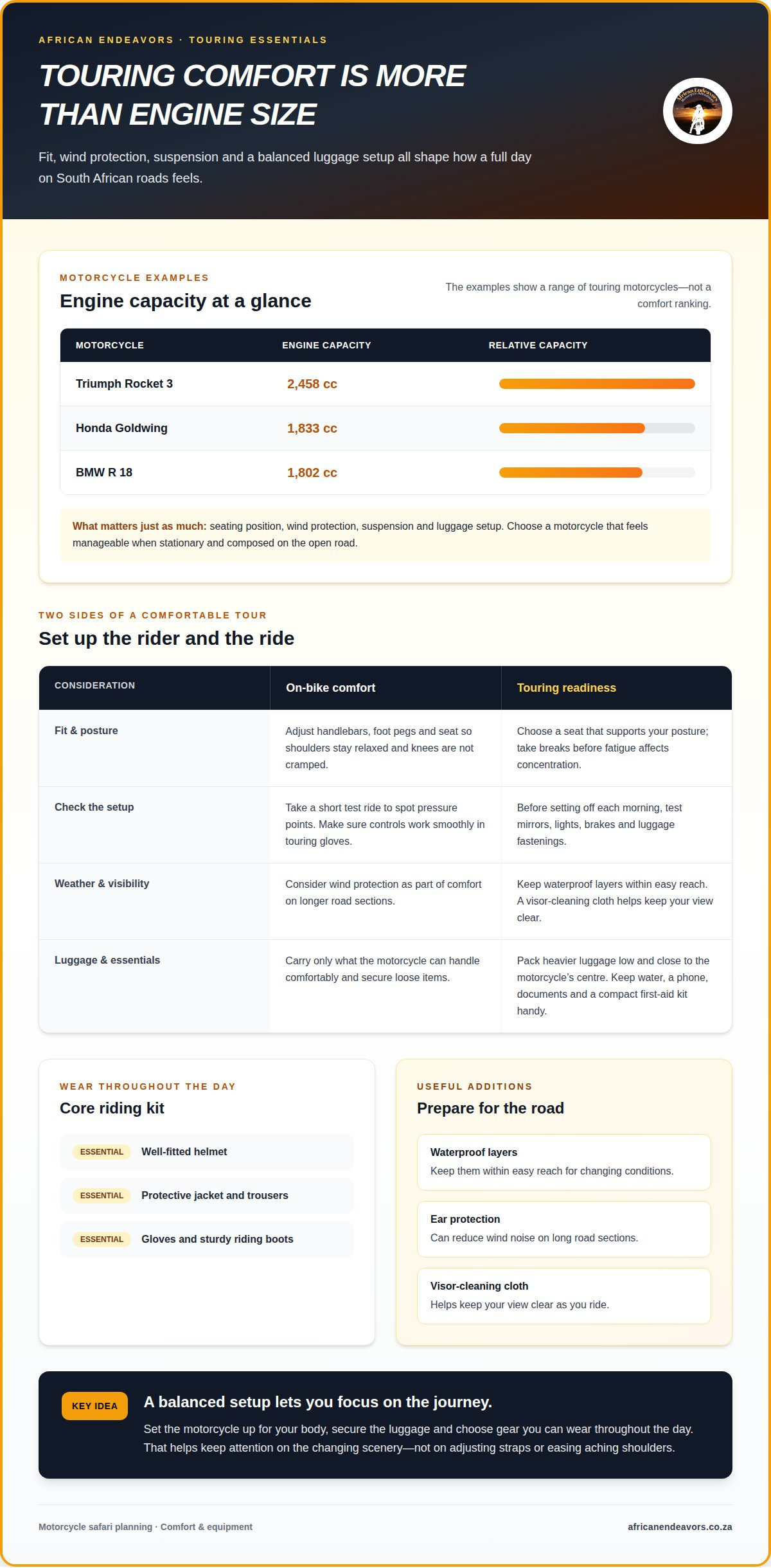
Comfort shapes how much you enjoy a full day on South African roads. Start with fit: adjust the handlebars, foot pegs and seat so your shoulders stay relaxed and your knees aren’t cramped. A short test ride can reveal pressure points before luggage and longer hours make them harder to ignore. Check that you can operate the controls smoothly in your touring gloves.
Engine size alone doesn’t determine comfort. The Triumph Rocket 3 has a 2,458 cc engine, whilst the Honda Goldwing has an 1,833 cc flat-six. The BMW R 18 has an 1,802 cc engine. These examples show the range of touring motorcycles, but seating position, wind protection, suspension and luggage setup matter just as much. Choose a motorcycle that feels manageable when stationary as well as composed on the open road.
Build your kit around the ride, not an imagined safari checklist. A well-fitted helmet, protective jacket and trousers, gloves and sturdy riding boots are the essentials. Add waterproof layers for changing conditions and keep them within easy reach. Ear protection can reduce wind noise on long road sections, while a visor-cleaning cloth helps keep your view clear.
- Pack evenly: Place heavier luggage low and close to the motorcycle’s centre, then secure every strap.
- Keep essentials handy: Store water, a phone, documents and a compact first-aid kit where they’re easy to reach.
- Check the controls: Test mirrors, lights, brakes and luggage fastenings before setting off each morning.
- Plan for comfort: Use a seat that supports your posture and take breaks before fatigue affects concentration.
For seeing the Big Five from a motorcycle, touring comfort also means staying ready to ride attentively between wildlife-viewing experiences. Secure loose items, carry only what the bike can handle comfortably and choose gear you can wear throughout the day. A balanced setup helps you focus on South Africa’s changing scenery instead of adjusting straps or easing aching shoulders.
3. Which South African national parks and reserves offer motorcycle access and Big Five wildlife viewing?
Separate riding through Big Five country from riding inside a wildlife reserve. Kruger National Park is a key destination for viewing lion, leopard, elephant, rhino and buffalo. A motorcycle route through the surrounding region does not, by itself, mean you can ride on the park’s internal roads.
Access depends on each park or reserve and the roads it permits motorcycles to use. Public approach roads and internal wildlife-viewing roads are different parts of a journey. Check each destination’s rules and plan around them instead of assuming every road is open to every vehicle.
Kruger shows why this distinction matters: travelling to the park and taking a motorcycle safari inside it are not automatically the same experience. Private reserves have their own access arrangements, too. Before settling on a route, use the destination’s official visitor information to establish where motorcycles may travel and how wildlife viewing is organised.
- Start with the destination: Name the national park or reserve, such as Kruger National Park, and identify the specific entrance and roads relevant to your plan.
- Separate the ride from viewing: Map motorcycle travel to the area, then identify which parts of wildlife viewing take place within the reserve.
- Read access conditions: Look for rules that name motorcycles, road types and permitted areas. A general vehicle reference may not answer the motorcycle question.
- Build a practical route: Keep scenic riding and wildlife viewing as distinct itinerary elements unless the destination’s own information explicitly connects them.
This distinction sets realistic expectations: seeing the Big Five from a motorcycle may involve riding through the wider region, then viewing wildlife under the reserve’s stated arrangements. Choose a park for both its wildlife and the motorcycle access it permits. Plan around specific destinations such as Kruger, and treat each reserve’s conditions as unique to that place.
Kruger National Park is a key destination for Big Five viewing, but motorcycle access to its roads depends on the park’s conditions. Check each park or reserve separately before planning to combine motorcycle touring with wildlife viewing.
4. Are motorcycles allowed on safari roads in Kruger National Park and other Big Five reserves?
Don’t assume a motorcycle can use every safari road in Kruger National Park. Access depends on the destination, and ordinary road travel is different from wildlife-viewing arrangements. The route into a reserve, its internal roads and any organised game-viewing activity are separate parts of the plan.
For Kruger, establish whether motorcycles are permitted on the specific roads you intend to ride. A road appearing on a map does not establish that motorcycles can use it. The same distinction applies at private Big Five reserves, where access arrangements vary by destination.
- Name the destination: Treat Kruger National Park and each private reserve as separate cases.
- Identify the road: Distinguish public approach roads from roads inside the reserve.
- Clarify the activity: Separate riding a motorcycle through an area from taking part in wildlife viewing.
- Plan a route alternative: Keep a scenic ride through the surrounding region distinct from time spent viewing wildlife.
Keeping these activities separate helps you shape a realistic itinerary. For example, you can plan a motorcycle journey through the Kruger region as a road tour, then organise wildlife viewing according to the arrangements inside the park. This avoids mistaking a scenic route for proof of motorcycle access on safari roads.
Use the same approach for any reserve: identify the destination, distinguish internal roads from approach routes, and plan around its stated access conditions. Motorcycle touring and Big Five viewing are related travel goals, but they don’t automatically happen on the same roads or in the same way.
A Kruger-focused itinerary can combine regional riding with wildlife experiences. The Kruger Park & Panorama Route Tour brings together these South African travel interests without assuming every safari road is open to motorcycles. Keep the distinction clear when planning, and treat each reserve’s access arrangements as specific to that destination.
Motorcycle access depends on the destination and the road. Check whether motorcycles are permitted on the internal roads you plan to use, and distinguish those from public approach routes and the reserve’s wildlife-viewing arrangements.
4. What are the best motorcycle routes for seeing the Big Five in South Africa?
Choose a route by separating the riding experience from the wildlife-viewing plan. Kruger National Park gives an itinerary a clear Big Five focus, while the Panorama Route adds a distinct scenic-riding element. Treat them as complementary travel goals, not proof that every road serves both purposes.
A Kruger-centred itinerary suits riders who want the park to anchor their journey. Plan motorcycle travel through the surrounding region, then arrange wildlife viewing according to the park’s access conditions. The Kruger Park & Panorama Route Tour brings these two South African destinations together in one touring option.
For riders who value a broader coastal and inland journey, the Garden Route & Route 62 Tour offers a different route identity. Its name signals a touring focus across those regions, rather than a promise of motorcycle access to Big Five safari roads. Keep the wildlife-viewing destination as a separate part of the plan.
- Prioritise wildlife: Make Kruger National Park the anchor, then plan the road journey around reaching the region.
- Prioritise scenery: Consider the Panorama Route alongside Kruger, while keeping park viewing arrangements distinct.
- Prioritise a wider ride: Choose the Garden Route & Route 62 for a different South African touring focus.
- Match the route to the ride: Decide whether the trip’s main draw is wildlife, scenic roads or a combination.
Route quality depends on how well each element fits your priorities. A Kruger-focused plan places wildlife viewing at its centre; a Panorama Route pairing adds a scenic dimension. The Garden Route & Route 62 offers another touring direction, but should not be presented as a substitute for a Kruger wildlife itinerary.
For a guided ride combining Kruger and the Panorama Route, explore the Kruger Park & Panorama Route Tour. Choose the route that makes sense for your priorities, then keep motorcycle access and wildlife viewing clearly planned as separate parts of the journey.
African Endeavors
African Endeavors offers guided motorcycle tours for riders planning a South African adventure, with routes shaped around distinct landscapes and touring styles. If Kruger and the Panorama Route are priorities, its Kruger Park & Panorama Route Tour provides a relevant option. The Wild Coast & Drakensberg and Garden Route & Route 62 tours offer different regional journeys, while Off-Road Dirt Bike Safaris suit riders drawn to off-road terrain.
Choose a guided tour if you want a structured ride without planning every route detail yourself. Keep the distinction clear: a motorcycle tour through a region is not the same as motorcycle access to safari roads or a wildlife-viewing activity inside a reserve. Match the route and riding style to the purpose of your trip.
Contact African Endeavors to discuss a guided motorcycle tour that suits your South African travel plans.
Shape your South African ride
Turn the idea of seeing the Big Five from a motorcycle into a journey that fits how you want to travel. Decide whether you want a wildlife-focused itinerary, a scenic ride through varied landscapes or a blend of both. That choice gives your planning direction without confusing motorcycle touring with access to reserve roads.
Look beyond the map, too. Consider the riding style you enjoy, how much time you want to spend on the road and how you want to balance open landscapes with wildlife experiences. A well-planned journey connects those priorities, giving each part a purpose instead of making the destination the only decision.
African Endeavors can help you explore a guided motorcycle journey suited to your South African travel plans. Contact African Endeavors to plan your trip, and take the first step towards an adventure shaped around the ride you want.
Frequently Asked Questions
Can you see lions, elephants, rhinos, leopards and buffalo safely from a motorcycle?
Not automatically. A motorcycle does not make close wildlife encounters safe: wild animals can behave unpredictably, and a bike offers less separation than an enclosed vehicle. Treat riding and wildlife viewing as distinct activities. Use viewing arrangements authorised by the reserve, follow its instructions and never approach or follow an animal to improve a sighting. Put distance and animal behaviour ahead of getting closer.
Are guided motorcycle safaris available in South Africa, and what do they cost?
Yes. African Endeavors offers guided motorcycle tours in South Africa, including adventure-bike, Harley-Davidson and off-road dirt-bike experiences. This format suits riders who want a guided journey rather than organising every element independently. Tour pricing depends on the itinerary, motorcycle, duration and included arrangements, and is provided after a quote request. The suitable option depends on the terrain and riding style you want.
What motorcycle, gear and safety preparations are recommended for a South African safari?
Choose a motorcycle suited to the planned terrain that feels manageable with luggage fitted. Before departure, arrange a mechanical inspection covering tyres, brakes, lights, fluids and the drive system. Pack a properly fitted helmet, gloves, protective jacket and trousers, and sturdy boots; add layers for changing conditions. Practise handling the loaded bike, and keep essential documents and a charged phone accessible during the ride.
