
The greatest threat to your African expedition isn’t a mechanical failure or a wandering leopard; it’s the slow, silent drain of your own physical and mental stamina. Successfully preparing for adventure bike safari Africa requires more than just a high-performance machine and a map; it demands a strategic approach to managing your energy so that you can savour every moment of the ride. You’ve likely spent hours imagining the vast, ochre horizons and the visceral thrill of navigating towering mountain ranges, yet the anxiety of mid-tour exhaustion or choosing the wrong gear can often overshadow the excitement.
We understand that the transition from a weekend rider to an intercontinental explorer is a significant leap. This guide provides the definitive blueprint to bridge that gap, ensuring you arrive at the starting line with the confidence of a seasoned professional. You’ll master a tailored physical training plan, discover a curated gear list that balances ventilation with premium protection, and learn how to navigate the intense heat of the continent’s vast interior. From technical preparation to mental fortitude, we’ll ensure you’re ready to embrace the raw beauty of dramatic coastlines or iconic wildlife reserves with absolute composure.
Key Takeaways
- Understand why building “saddle time” on diverse terrain is more critical than traditional gym work for enduring 300 kilometres of daily gravel.
- Discover how to balance high-performance protection with essential ventilation by selecting the right mesh gear and modular helmets for the African climate.
- Master the art of preparing for adventure bike safari Africa by leveraging a professional support vehicle to keep your bike light and your focus on the landscape.
- Learn the specific science of evaporative cooling and group dust protocols to maintain visibility and physical comfort throughout the journey.
- Gain the confidence that comes from expert local logistics, ensuring your expedition through the Drakensberg or Kruger Park is both wild and meticulously managed.
Physical and Mental Conditioning: Building Safari Stamina
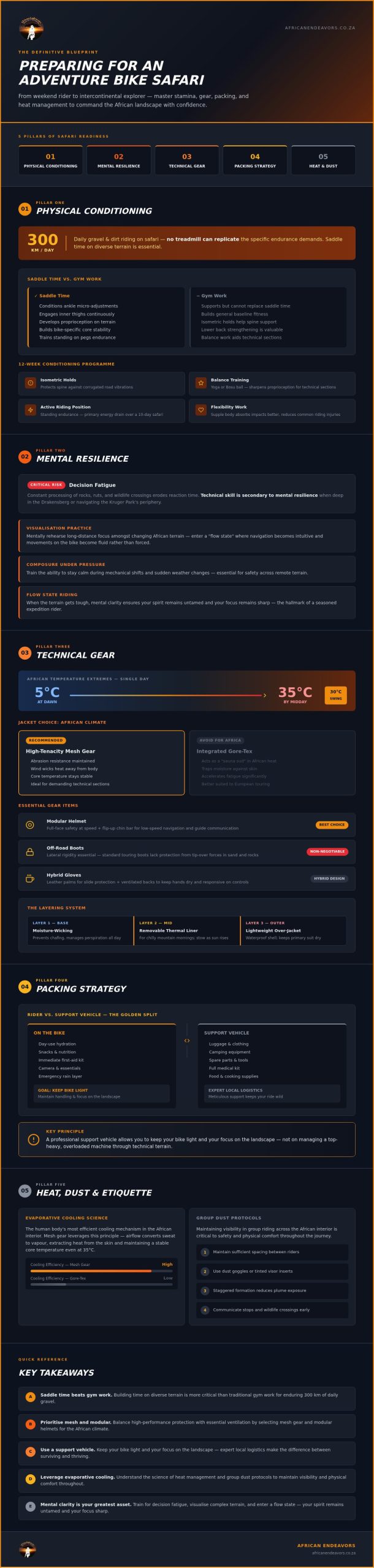
The vastness of the South African interior is best experienced from the seat of a high-performance adventure bike, but the physical toll of 200 to 300 kilometres of daily gravel and dirt is often underestimated. Whilst general fitness provides a baseline, preparing for adventure bike safari Africa requires a specific type of endurance that no treadmill can replicate. It’s about maintaining composure when the track turns to deep sand or loose shale; you must ensure your body remains a fluid shock absorber rather than a rigid weight on the machine. This physical resilience is what allows you to transition from merely surviving the day to truly commanding the landscape.
Many riders assume that heavy lifting in the gym translates directly to safari readiness. However, “saddle time” is the only way to condition the specific muscle groups used for hours of standing on the pegs. It’s the micro-adjustments in your ankles and the constant engagement of your inner thighs that prevent early-onset fatigue. Gym work certainly supports this, but it cannot replace the visceral experience of managing a heavy bike through undulating terrain. Without specific core strength, the effort required to lift a bike in sand or stabilise it in mud will quickly deplete your reserves, leaving you vulnerable to mistakes.
A 12-Week Conditioning Programme
To truly prepare, focus on isometric holds and lower back strengthening to support your spine against the constant vibrations of corrugated roads. Incorporate balance-based workouts, such as yoga or Bosu ball training, to sharpen your proprioception for technical sections. The active riding position is the primary energy drain during a 10-day safari, requiring you to stand for extended periods to lower the centre of gravity. Finally, prioritise flexibility; a supple body absorbs impacts better and significantly reduces the risk of common riding injuries amongst the dust and heat.
Mental Preparation for Remote Landscapes
Technical skill is secondary to mental resilience when you’re deep in the Drakensberg or navigating the Kruger Park’s periphery. You must prepare for “decision fatigue,” a state where the constant processing of rocks, ruts, and wildlife crossings begins to erode your reaction time. Staying calm during mechanical shifts or sudden weather changes is essential for safety. Visualising long-distance focus amongst changing African terrains helps you enter a “flow state,” where navigation becomes intuitive and your movements on the bike are fluid rather than forced. This mental clarity ensures that when the terrain gets tough, your spirit remains untamed and your focus remains sharp.
Technical Gear: Balancing Protection and Ventilation
Selecting the correct kit for the South African interior is a masterclass in managing extremes. In the high-altitude regions of the Drakensberg or the arid stretches of the Karoo, temperatures can swing from a crisp 5°C at dawn to a blistering 35°C by mid-afternoon. Preparing for adventure bike safari Africa requires a departure from standard European touring logic. Whilst integrated Gore-Tex membranes are the gold standard for rain, they often act as a “sauna suit” in the African heat, trapping moisture against the skin and accelerating fatigue. Instead, high-tenacity mesh gear provides the necessary abrasion resistance whilst allowing the wind to wick away heat, keeping your core temperature stable during demanding technical sections.
Your choice of helmet and footwear is equally critical. A modular helmet is the connoisseur’s choice for safari work; it offers the uncompromised safety of a full-face lid at speed but allows you to flip the chin bar up during low-speed navigation or when communicating with your guide. Below the waist, high-quality off-road boots are non-negotiable. A standard touring boot lacks the lateral rigidity required to protect your ankles from the crushing forces of a tip-over in sand or rocks. Finally, your gloves must be a hybrid of toughness and breathability; look for leather palms for slide protection paired with ventilated backs to keep your hands dry and responsive on the controls.
The Layering System for African Safaris
Efficiency in packing starts with a sophisticated layering system. Utilise moisture-wicking base layers to prevent chafing and manage perspiration throughout the day. A removable thermal liner is essential for those chilly morning starts in the mountains, but it should be easily stowed as the sun rises. For rain, a lightweight waterproof over-jacket is superior to integrated membranes because it keeps your primary suit dry and doubles as a windbreaker on long tarmac liaisons. This modular approach ensures you remain comfortable regardless of the shifting micro-climates you’ll encounter on expertly curated South African routes.
Essential Body Armour
Safety is the foundation of confidence. We recommend upgrading all factory inserts to Level 2 CE-rated limb and back protection to ensure maximum energy absorption in an impact. For those venturing into more technical terrain, neck braces and chest protectors provide a vital safety net against the unpredictable. Ensure your gear fits comfortably whilst you are standing on the footpegs; armour that shifts or pinches in an active off-road stance will quickly become an unbearable distraction. When preparing for adventure bike safari Africa, your gear should feel like a second skin, robust enough to protect you yet flexible enough to allow for total freedom of movement.
Packing Strategy: The Rider vs. The Support Vehicle
One of the most profound shifts in preparing for adventure bike safari Africa with a professional outfit is the transition from a pack-mule mentality to the luxury of unburdened riding. When you aren’t wrestling with 40 kilograms of luggage strapped to the subframe, the bike’s handling remains sharp and predictable; this allows you to focus entirely on the rhythm of the trail. The support vehicle isn’t merely a convenience; it’s a performance enhancer that preserves your stamina by keeping your machine light and agile through technical river crossings or sandy double-tracks. This strategic division of gear ensures that your primary kit is waiting for you at the lodge, whilst you carry only the essentials required for the day’s navigation.
Organising your main kit for easy access at the end of a long day is a ritual that saves precious minutes of rest. By separating your riding gear from your evening attire, you can quickly transition from the dust of the trail to the comfort of the fire pit. This methodical approach to packing ensures that even after eight hours in the saddle, your arrival at the overnight destination is seamless and stress-free.
The “Daily Bag” Essentials
Your on-bike storage should be minimalist and meticulously organised. We recommend a small, dust-proof tank bag or tail pack specifically for your electronics, spare batteries, and sunblock. Protecting your passport and medical information is paramount; these should be kept in waterproof, tethered pouches within your riding jacket or a secure pocket. However, the most critical component of your daily setup is a high-quality hydration bladder. In the arid heat of the South African interior, consistent sipping is the only way to prevent the cognitive decline associated with dehydration. For more detailed insights on managing your kit, see our guide on Packing for a Multi-Day Mountain Motorcycle Adventure.
The Support Vehicle Stash
For the main luggage stored in the support truck, soft luggage is vastly superior to hard panniers. Soft bags are easier to stack, more resilient to the vibrations of corrugated roads, and far less likely to damage other gear in the vehicle. This is where you’ll store your “civilian” clothes for evenings spent at luxury lodges, where a fresh change of attire is a welcome ritual after a day in the dust. Additionally, pack a dedicated “electronics charging station”, a small bag containing all your cables, power banks, and international adapters. This allows you to simply plug in one unit at the overnight stop rather than hunting for loose wires in the bottom of a dark duffel bag. By refining your approach to preparing for adventure bike safari Africa, you ensure that the logistics remain invisible, leaving only the thrill of the ride.
Navigating the Environment: Heat, Dust, and Etiquette
The African sun is an omnipresent force that dictates the rhythm of your journey through the bush. Preparing for adventure bike safari Africa means acknowledging that heat isn’t just a discomfort; it’s a physiological challenge that requires a scientific approach. Whilst the wind of your movement provides a deceptive cooling effect, it simultaneously masks the rapid evaporation of moisture from your skin. You may feel dry and relatively cool, yet your body is losing litres of fluid and essential salts every hour. Mastering the science of evaporative cooling involves keeping your base layers damp and your vents open, allowing the airflow to regulate your core temperature without prematurely depleting your physical reserves.
Navigating these landscapes also demands a keen awareness of group dynamics and cultural sensitivity. Dust is the constant companion of the off-road explorer, and managing it requires strict protocols. When riding in a pack, maintain a “dust gap” of at least 100 to 200 metres on open tracks; this ensures every rider has clear visibility and sufficient time to react to hidden hazards. Beyond the trail, your behaviour in remote communities is paramount. Slowing down when passing through rural villages to minimise dust and noise is more than just polite; it’s an essential mark of respect for the people who call these wild spaces home.
The Hydration Protocol
Success begins 24 hours before you even swing a leg over the saddle. Pre-hydrating ensures your cellular levels are topped up before the first dust trail appears on the horizon. Once on the move, adopt the “sip every 15 minutes” rule; small, frequent intakes are far more effective for maintaining cognitive function than large, infrequent gulps. Hyponatremia is a dangerous condition where sodium levels in the blood become diluted by excessive plain water intake, making the addition of electrolytes and salts to your hydration bladder an absolute necessity for any rider facing the African heat.
Dust and Sun Protection
Protecting your respiratory system is just as vital as protecting your limbs. Use high-quality buffs and specialised filters to shield your lungs from the fine, powdery silt that can hang in the air for minutes after a bike has passed. Even under the shade of a full-face helmet, the African sun is relentless; high-SPF sunblock is essential to prevent windburn and long-term UV damage. For eye care, select goggles with light-sensitive lenses or visors with specific tints designed to manage the high-glare environments of the open South African plains. If you’re ready to experience this curated balance of wild exploration and professional support, book your South African motorcycle safari today.
The African Endeavors Advantage: Expert Logistics
Local expertise is the invisible safety net that transforms a daunting expedition into a seamless masterclass of exploration. Whilst some operators merely provide a machine and a GPS track, our approach is rooted in a deep, generational understanding of the South African landscape. Our professional guides don’t just navigate; they interpret the terrain, anticipating the shifting sands of the interior or the unpredictable weather patterns of the mountains before they become obstacles. This level of meticulous management is the cornerstone of preparing for adventure bike safari Africa, allowing you to shed the anxiety of remote logistics and focus entirely on the visceral connection between rider, machine, and the wild.
Our all-inclusive philosophy ensures that the dream and the plan are perfectly aligned. By handling the complexities of fuel logistics, mechanical contingencies, and route scouting, we reduce your personal preparation burden to just two factors: your physical conditioning and your personal gear. This curated approach means you aren’t just a tourist; you’re a guest with a front-row ticket to an exclusive world of high-octane discovery where every detail is managed with formal hospitality and professional rigour.
Premium Support and Machinery
The heart of our service is a high-performance fleet maintained to the most exacting standards. Whether you’re commanding an adventure bike through the Off-Road Dirt Bike Tour Wild Coast or exploring the Kruger Park and Panorama Route, the machinery is prepared to perform flawlessly in raw, untamed environments. Peace of mind is provided by our dedicated support vehicles, which follow every tour with mechanical aid, spare parts, and your luggage. This isn’t a luxury; it’s a safety essential that ensures a minor technical glitch remains a brief footnote rather than a journey-ending event. We meticulously curate every itinerary to balance the adrenaline of the trail with the luxury of premium lodges, ensuring your rest is as high-performance as your ride.
Your Next Steps to Adventure
To begin your journey, choose between our pre-scheduled departures or collaborate with us to organise a bespoke group expedition tailored to your specific desires. Preparing for adventure bike safari Africa also involves ensuring your documentation is in order; international riders typically require an International Driving Permit (IDP) alongside their national motorcycle licence to comply with South African regulations. Ensure your travel insurance specifically covers off-road motorcycling to provide comprehensive protection. Before you fly into the heart of the adventure, consult our final checklist to ensure your gear, fitness, and mental state are primed for the journey of a lifetime. If you’re weighing your options between different expedition styles, our dual sport motorcycle tour South Africa comparison guide offers an in-depth breakdown of the technical demands across our most popular routes. The wild is waiting; are you ready to answer?
Command the Horizon: Your Safari Awaits
Successfully preparing for adventure bike safari Africa is a journey that begins long before you touch down on South African soil. It’s a commitment to refining your physical stamina, mastering the nuances of technical gear, and embracing the methodical logistics required for remote exploration. You now possess the definitive blueprint to navigate the dust of the Wild Coast and the heat of the interior with absolute composure. By focusing on managing your energy and leveraging professional support, you transform a rugged expedition into a curated, high-performance event.
We provide the ultimate safety net for your ambitions. Our tours are fully supported by local experts who understand every rut and rhythm of the terrain. You’ll command a fleet of high-performance BMW and KTM adventure bikes, specifically chosen for their reliability and power. After a day of visceral thrills, you’ll retreat to luxury lodge accommodation that offers the perfect sanctuary for recovery and reflection. Explore our all-inclusive motorcycle safari packages and book your 2026 adventure today. The ancient landscapes of South Africa are calling; it’s time to answer with the confidence of a rider who is truly prepared.
Frequently Asked Questions
Do I need a special motorcycle licence to ride in South Africa?
Yes, you must possess a valid motorcycle licence from your home country that covers the engine capacity of the bike you’ll be riding. International riders almost always require an International Driving Permit (IDP) to accompany their national licence. This document translates your credentials into a format recognised by South African authorities. It’s a critical part of preparing for adventure bike safari Africa, ensuring you’re legally compliant when traversing the diverse provinces of the Republic.
How much off-road experience is required for an adventure bike safari?
Whilst our expert guides provide extensive support, a baseline of off-road proficiency is essential for your safety and enjoyment. You should be comfortable standing on the footpegs and managing a heavy machine on loose gravel or dirt tracks. If you’re primarily a road rider, we recommend attending a dedicated adventure riding school before your tour begins. This preparation allows you to focus on the majestic scenery rather than just the technicalities of the trail.
What happens if I have a mechanical failure in a remote area?
You’re never truly alone on our expeditions because every tour is accompanied by a professional support vehicle. This vehicle carries essential spare parts, tools, and a dedicated mechanic capable of handling most trailside repairs. If a bike cannot be fixed immediately, we provide a backup machine from our fleet to ensure your journey continues without delay. This meticulous logistical support is what distinguishes a premium guided experience from a vulnerable, solo expedition.
Is it safe to ride a motorcycle through African wildlife areas?
Yes, provided you strictly adhere to the safety protocols established by our local guides. We avoid riding in areas with high predator concentrations during the sensitive times of dawn or dusk, and we never approach large mammals like elephants or buffalo too closely. Our guides possess deep terrain knowledge and understand animal behaviour, ensuring that every wildlife encounter is a respectful and thrilling experience. Safety remains our primary mandate whilst navigating these untamed landscapes.
Can I bring my own riding gear, or is it provided?
We strongly encourage you to bring your own riding gear to ensure a perfect, comfortable fit. Your helmet, boots, and suit are your primary protection; using familiar equipment reduces the risk of blisters or discomfort during long days in the saddle. Whilst we provide the high-performance motorcycle and mechanical support, your personal kit is a vital component of preparing for adventure bike safari Africa. Ensure your gear is cleaned and inspected before you arrive.
How do I manage my luggage during a multi-day guided tour?
Your main luggage is transported in our dedicated support vehicle, allowing you to ride unburdened and agile. You only need to carry a small day-bag or hydration pack on your person for essentials like sunblock, cameras, and documents. This system preserves your stamina and allows the bike to handle as the manufacturers intended. At the end of each day, your luggage will be waiting for you at our luxury lodge accommodation, ready for a fresh change.
What is the best time of year to prepare for an African bike safari?
The most favourable riding conditions in South Africa typically occur during the autumn and spring months, from March to May and September to November. During these periods, the temperatures are moderate and the dust is often settled by occasional light rains. Preparing for your tour should begin at least six months in advance to allow for physical conditioning and gear testing. This timeline ensures you’re at peak readiness when the dry, golden winter season arrives.
Will I have mobile phone reception in the remote areas of the tour?
Mobile reception is generally excellent in South African towns, but it becomes intermittent or non-existent in remote mountain passes and deep bushveld. Our guides carry satellite communication devices for emergency situations, ensuring a constant link to the outside world regardless of cellular coverage. We encourage you to embrace these “dead zones” as a rare opportunity for digital detoxification. You can share your high-octane stories once we return to the connectivity of the lodge.
