
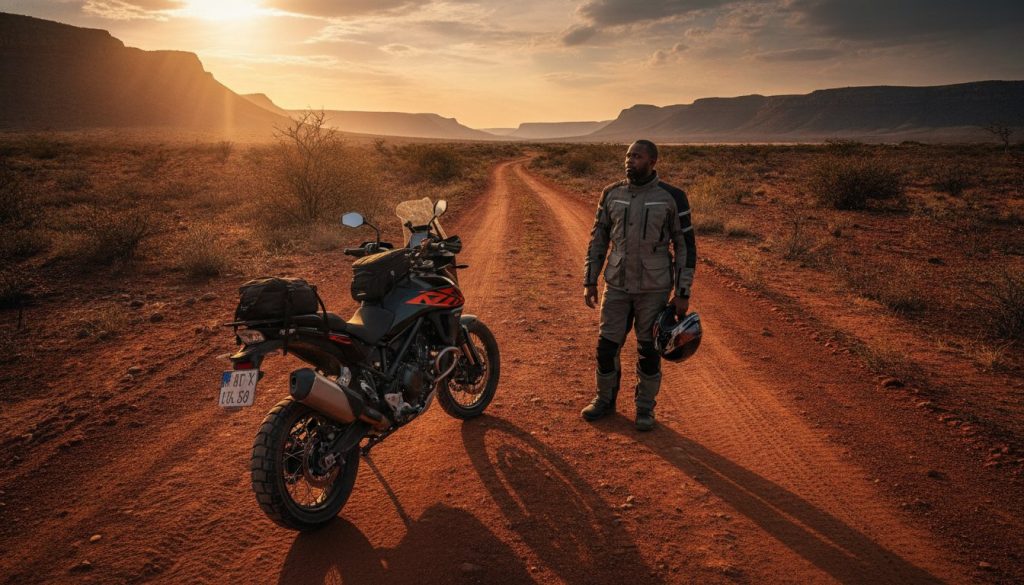
What if the secret to conquering Africa’s vast, sun-baked landscapes isn’t what you strap to your bike, but what you leave in the support vehicle? You’ve likely spent weeks wondering what to pack for motorcycle safari Africa, perhaps worrying about the sharp temperature shifts between a frost-nipped morning in the highlands and the searing heat of the humid plains. It’s natural to feel the urge to overpack when facing the untamed wilderness, but carrying unnecessary weight only hinders your freedom across the diverse terrain.
Our expert-led checklist is designed for the discerning rider who demands both raw adventure and refined comfort. We’ll show you how to streamline your gear while ensuring you’re prepared for the latest 2026 ECE 22.06 safety standards and the new R500 Electronic Travel Authorisation fees. You will discover how to balance essential personal protective equipment with the luxury of our fully supported tours, giving you the confidence to leave the heavy lifting to us and focus entirely on the throttle and the horizon.
Key Takeaways
- Prioritise CE-rated armour and high-ventilation helmets to ensure maximum protection and comfort across diverse South African terrains.
- Discover what to pack for motorcycle safari Africa by separating daily essentials from bulky gear, utilising our support vehicle to keep your machine nimble.
- Master the art of layering with technical base layers designed to wick moisture during humid coastal stretches and retain heat in the arid interior.
- Streamline your logistics by confirming your International Driving Permit and passport validity to ensure a seamless transition across every frontier.
- Align your physical preparation with the unique demands of rugged routes like the Wild Coast to fully immerse yourself in the sensory thrill of the journey.
Superior Protection: Selecting Your Primary Riding Gear
The roar of a high-performance engine against the silence of the Great Karoo is a visceral sensation like no other. To truly enjoy this experience, your protective layer must be as meticulously curated as the route itself. Whether you are tackling the technical gravel of the Wild Coast or leaning into the sweeping bends of Route 62, CE-rated armour is non-negotiable. It provides the necessary impact resistance whilst remaining flexible enough for long days in the saddle. When considering what to pack for motorcycle safari Africa, your choice of protective apparel is the thin line between a minor tumble and a journey-ending injury.
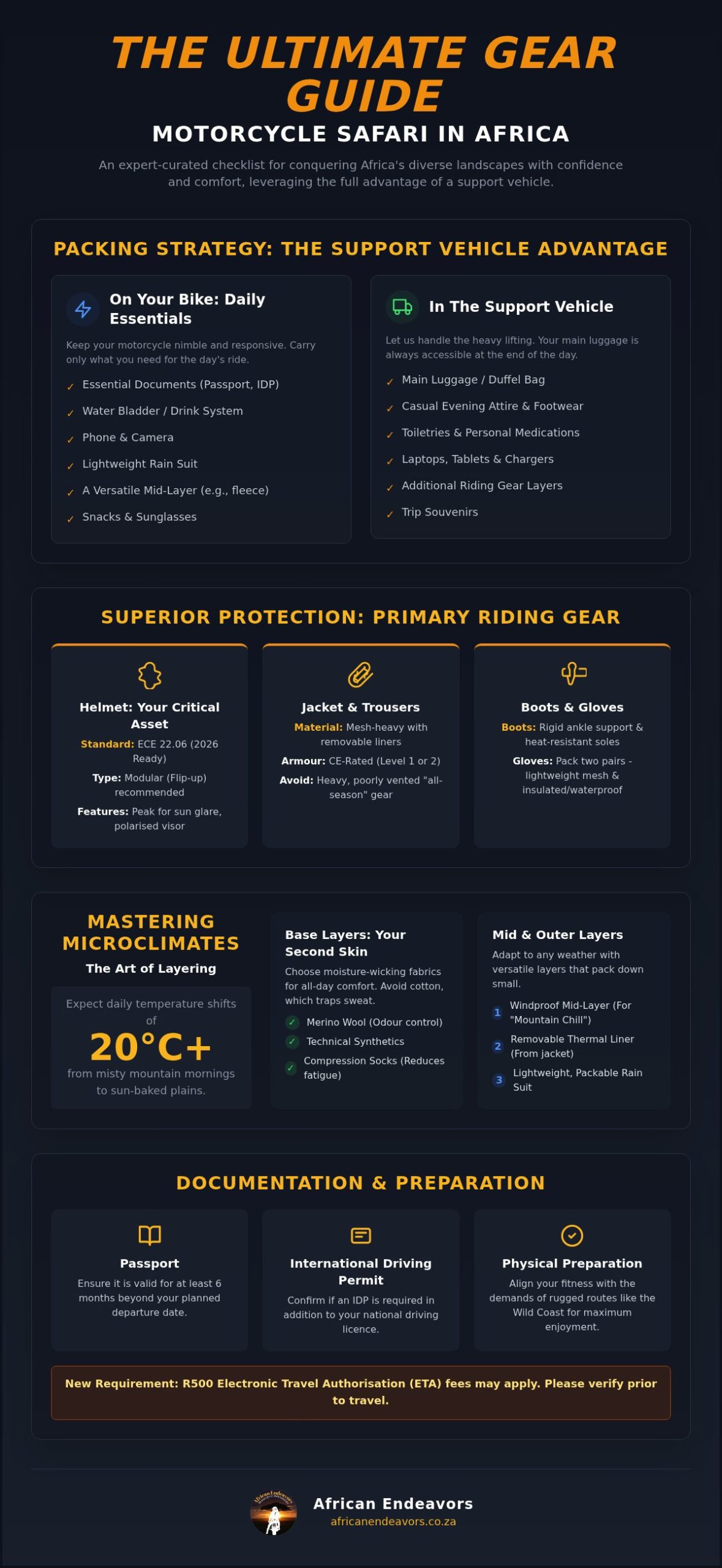
Standard motorcycle touring preparations often overlook the specific intensity of the Southern African climate, where the sun is as much an adversary as the terrain. Pack with precision. You’ll need two pairs of gloves: lightweight mesh for the humid coastal air and waterproof, insulated versions for the biting morning mist of the Drakensberg. Your boots must be more than just sturdy; they require rigid ankle support for off-road sections and heat-resistant soles to withstand the warmth radiating from a large-displacement engine during slow-speed technical manoeuvres.
The Helmet: Your Most Critical Asset
Safety standards have evolved. For a 2026 expedition, ensure your helmet meets the latest ECE 22.06 certification, which is now one of the most demanding global benchmarks for impact testing. A peak is not merely a fashion statement; it is a vital tool for reducing the blinding glare during those golden-hour rides across the vast plains. We highly recommend a modular, or flip-up, helmet for our premium tours. This design allows for effortless communication with your guide and quick photography of a sudden wildlife sighting without the hassle of removing your gear. Ensure your visor or goggles are polarised to manage the high-contrast light that defines the African landscape.
Jackets and Trousers: Versatility is Key
Mesh is king in the Southern Hemisphere. While many riders arrive with “all-season” gear, these heavy textiles often fail when the mercury climbs toward 35 degrees because the venting simply cannot move enough air. A mesh-heavy adventure jacket with a removable thermal liner offers the best of both worlds, keeping you cool in the Lowveld and warm during a mountain pass crossing. The requirements shift slightly depending on your chosen adventure. For our Off-Road Dirt Bike Safaris, many riders prefer a separate pressure suit under a lightweight jersey for maximum airflow. Conversely, those on our Harley Davidson Scenic Tours often opt for integrated armour within a more classic, abrasion-resistant textile or leather jacket that suits the refined pace of the Garden Route.
Mastering the Microclimates: Layering for Diversity
Riding through South Africa is a lesson in geographical theatre. One moment you are tracing the humid, salt-sprayed curves of the Garden Route; the next, you are ascending the Great Escarpment where the air thins and the temperature plummets. This volatility is why layering is the cornerstone of any professional packing strategy. It allows you to adapt instantly without the need for frequent, time-consuming stops that disrupt the rhythm of the journey.
When deciding what to pack for motorcycle safari Africa, you must account for the dramatic 20-degree shifts between a misty morning in the Drakensberg and a sweltering afternoon in the Kruger. It is about maintaining a stable core temperature to ensure your focus remains on the trail, not your physical discomfort. The “Mountain Chill” is a visceral reality that can sap your energy if you aren’t prepared with a high-quality, windproof mid-layer that fits comfortably beneath your primary jacket. Understanding the best time for a guided motorcycle tour in South Africa is equally important, as the season you choose will directly influence which layers you’ll rely on most.
Base Layers and Moisture Management
Technical base layers are your first line of defence against the elements. We recommend Merino wool over synthetic alternatives for its exceptional odour control and natural temperature regulation during multi-day trips. Unlike cotton, which traps moisture and leads to chilling or chafing, Merino wicks sweat away whilst keeping you insulated during high-altitude climbs. Don’t overlook compression socks; they are a secret weapon for reducing lower-leg fatigue and swelling during those exhilarating 300km+ days across the Karoo. Maintaining your physical well-being is as vital as following CDC travel health information for safaris to ensure you remain in peak condition for every technical section.
Weatherproofing for Coastal and Mountain Rains
Rain in South Africa is rarely predictable. A coastal mist along the Wild Coast can be just as soaking as a high-veld thunderstorm. Pack a compact, high-visibility rain suit that stows away into a tiny pouch, ready to be deployed over your main gear in seconds. A Gore-Tex membrane functions by utilising billions of microscopic pores that are small enough to block liquid water droplets from entering while remaining large enough to allow sweat vapour to escape into the atmosphere. This breathability is essential in high-humidity environments where a standard plastic poncho would leave you drenched in perspiration. Keep these stow-away waterproofs in your day pack for immediate access when the clouds gather over a mountain pass.
If you’re ready to test your gear against the elements, our Wild Coast & Drakensberg Tour provides the perfect proving ground for any serious rider.
Packing Strategy: Leveraging the Support Vehicle Advantage
The weight of the world belongs in the chase truck, not on your suspension. Traditional adventure touring often demands a compromise; you must choose between carrying essential supplies and maintaining the agile handling of your machine. On a premium expedition, that compromise vanishes. By leveraging a dedicated support vehicle, you transform the mechanical dynamics of your ride. A lighter bike is a more responsive bike, allowing you to flick through the technical hairpins of the Panorama Route with an effortless precision that laden panniers would otherwise destroy.
When refining your list of what to pack for motorcycle safari Africa, adopt the “Day Pack” philosophy. This strategy dictates that you only carry what is vital between the morning’s first ignition and the evening’s final sundowner. Everything else, from your heavy tools to your evening attire, travels in the climate-controlled security of our support vehicle. This isn’t just about convenience; it’s a fundamental shift in how you experience the landscape. You aren’t just a traveller moving luggage; you’re a rider fully immersed in the grit and glory of the trail.
The Day Pack: Essentials for the Saddle
Your day pack should be a compact, ergonomic companion that houses your immediate necessities. Hydration is paramount. The African sun is relentless, and we recommend a hydration bladder with a minimum capacity of 2 to 3 litres to maintain cognitive function and physical stamina. Alongside your water, keep high-SPF sunblock and lip balm within easy reach to combat the drying winds of the highveld. Don’t forget your quick-access documents. Your national driving licence, International Driving Permit, and a hard copy of your emergency contact details should be kept in a waterproof sleeve in your tank bag or backpack for seamless transitions at checkpoints.
Main Luggage: Comfort at the Lodge
Once the dust is settled and the engines are cooling, the “After-Ride” experience begins. This is where the luxury of a supported tour truly shines. Your main luggage, safely transported for you, should include casual yet sophisticated attire suitable for lodge dinners under the stars. We suggest packing a dedicated pair of walking shoes or sturdy boots for evening wildlife walks or exploring the grounds of a private reserve. Organising your gear with packing cubes is a masterstroke for rapid transitions; it allows you to find your evening essentials in seconds without deconstructing your entire bag. This methodical approach ensures that the transition from the raw intensity of the trail to the refined hospitality of the lodge is as smooth as your gear changes.
Documentation and Health: Preparing for the Frontier
The roar of the engine is only as secure as the paperwork in your jacket pocket. Before you ignite the machine, you must ensure your administrative foundation is unshakeable. Your passport is your primary key; it must be valid for at least six months beyond your departure date. For those entering South Africa in 2026, be prepared for the R500 Electronic Travel Authorisation (ETA) fee, or a total of R925 if your nationality requires a full tourist visa application. These are the small but vital details that separate a seamless crossing from a bureaucratic nightmare at the border.
Alongside your national motorcycle licence, an International Driving Permit (IDP) is mandatory for legal compliance on South African roads. We also insist on comprehensive travel insurance that specifically covers high-displacement motorcycle touring and adventure sports. With medical evacuation costs from remote safari camps ranging between R1.3 million and R2.7 million, having both digital and physical copies of your policy isn’t just a suggestion; it’s a critical safety protocol. When considering what to pack for motorcycle safari Africa, your documentation is the most lightweight yet powerful gear you’ll carry.
Essential Paperwork and Digital Backups
Digital redundancy is your best ally in the wilderness. Store high-resolution scans of your passport, IDP, and insurance in a secure, offline-accessible cloud folder. Whilst we handle the complex logistics like the Carnet de Passages for our cross-border expeditions, you should carry a physical “In Case of Emergency” (ICE) card in your jacket’s transparent sleeve. This card should list your blood type, allergies, and emergency contact details, providing immediate information to our medical staff if you’re unable to do so yourself.
The Rider’s Medical and Wellness Kit
Physical endurance is the engine that drives your journey. Beyond the standard first-aid supplies provided by our support team, your personal kit should focus on recovery and environmental protection. High-SPF sun protection and anti-malarial medication are essential, especially for the humid northern reaches. To combat “Biker Fatigue,” pack electrolyte sachets and magnesium supplements to aid muscle recovery and maintain focus whilst navigating technical terrain. A personal first-aid kit ensures you can manage minor irritations immediately, keeping you in peak condition for every mile of the trail.
If you’re ready to explore the legendary trails of the North, our Kruger Park & Panorama Route Tour offers a world-class blend of wildlife sightings and winding mountain passes.
Curated Excellence: Preparing for Your African Endeavors Safari
The journey to the heart of the continent begins long before you set foot on the tarmac. It starts in the quiet moments of preparation, where the anticipation of the trail meets the meticulous planning of a professional expedition. When you consider what to pack for motorcycle safari Africa, remember that your most valuable asset is your own physical and mental readiness. A multi-day trek through the rugged landscapes of the Drakensberg or the Wild Coast is as much a test of endurance as it is a showcase of skill, requiring a rider who is as resilient as their machinery.
Pre-Departure Bike and Body Prep
Long days in the saddle require more than just enthusiasm; they demand core strength and flexibility. Focus your training on the muscles that stabilise your ride, allowing you to absorb the undulations of the gravel with grace rather than tension. This physical foundation is what enables the “flow state,” that rare psychological space where the bike becomes an extension of your intent. Equally critical is the final gear check. Never arrive with pristine, untested equipment. New adventure boots, for instance, should be broken in at least a month prior to departure to avoid the distraction of blisters during a technical ascent. Every strap, buckle, and technical layer should feel familiar, ensuring your focus remains on the ancient history etched into the horizon rather than a pinching seam.
Booking Your All-Inclusive Expedition
True freedom is found when the logistics are invisible. By choosing a professional gatekeeper to adventure, you ensure that the transition from a structured plan to a wild dream is entirely seamless. Our role is to manage the complexities of the frontier, from mechanical support to the curated luxury of your evening accommodation, leaving you free to absorb the sensory overload of a wildlife sighting or the visceral thrill of a coastal curve. Whether you are leaning into the bends on one of our Harley Davidson Scenic Tours or navigating the raw terrain of an off-road safari, clear communication with our team is key. Share your bike preferences and any specific gear requirements early, allowing us to tailor the experience to your exact standards.
The horizon is calling, and the trails of the South are ready for those bold enough to answer. Enquire about our upcoming luxury motorcycle safaris today and take your place at the front of the pack, where the air is clear and the road is yours to command.
Master the Trail and Claim Your African Horizon
The dust of the Kalahari and the mists of the Wild Coast are no longer mere daydreams; they are the tangible rewards of a rider who prepares with precision. By mastering what to pack for motorcycle safari Africa, you’ve ensured that every technical choice, from CE-rated armour to moisture-wicking Merino layers, serves a singular purpose: your total immersion in the landscape. You now understand that a lighter machine leads to a more exhilarating ride, especially when our professional chase vehicles handle the heavy lifting. Our expert local guides, backed by decades of riding experience, are ready to lead you through the Great Escarpment on a high-performance adventure or cruiser fleet that defines mechanical excellence.
The plan is complete. It’s time to trade the checklist for the throttle and experience the raw beauty of the South with the peace of mind that only a fully supported tour can provide. Book your high-performance motorcycle safari with African Endeavors and discover the visceral thrill of a journey where every detail is curated for your success. We’ll see you at the first light of dawn.
Frequently Asked Questions
Do I need to carry my own tools on a guided motorcycle safari?
No, you don’t need to carry a heavy tool roll or spare parts on your machine. Our dedicated support vehicle accompanies every multi-day tour, equipped with a comprehensive mechanical kit and expert staff to handle everything from tyre changes to technical adjustments. This allows you to focus on the terrain without the burden of extra weight on your motorcycle.
What is the best type of helmet for riding in South Africa?
An ECE 22.06 certified modular or adventure helmet is the gold standard for South African conditions. These designs offer the versatility of a peak to block the intense sun and the convenience of a flip-up front for quick communication or photography. Ensure your choice features superior ventilation to manage the heat during humid coastal stretches or arid interior trails.
How much luggage can I bring if there is a support vehicle?
You should limit your main luggage to one medium-sized soft-shell bag, typically weighing between 15kg and 20kg. Because we provide high-performance motorcycles and a chase vehicle, you only need a small day pack on the bike for your immediate essentials. This ensures our support vehicle has ample space for everyone’s gear whilst keeping your ride light and nimble.
Is an International Driving Permit mandatory for riding in Africa?
Yes, an International Driving Permit (IDP) is a legal requirement for riding in South Africa and most neighbouring countries. It serves as an official translation of your national licence and is frequently requested at checkpoints. You must always carry your IDP alongside your valid national motorcycle licence to ensure full legal compliance throughout your journey.
What should I wear for an evening safari at the lodge?
Casual luxury attire is the standard for lodge dinners and sundowners after a day on the trail. When considering what to pack for motorcycle safari Africa, include comfortable chinos or trousers, a collared shirt, and a lightweight jacket for the evening chill. Closed walking shoes are essential for safety and comfort during twilight wildlife walks around the camp perimeter.
How do I stay hydrated whilst riding in the African heat?
Utilise a 2 to 3-litre hydration bladder integrated into your riding pack to ensure constant, hands-free access to water. Don’t wait until you feel thirsty; take small, frequent sips to combat the drying effects of the wind and heat. We also recommend adding electrolyte sachets to your water to replace essential minerals lost through perspiration during long riding days.
Can I bring my own motorcycle gear or should I hire it?
We strongly recommend bringing your own personal protective equipment (PPE) to ensure a perfect fit and familiar comfort. Whilst we provide the high-performance machinery, wearing your own broken-in boots and helmet significantly reduces the risk of discomfort or distraction. This familiarity is vital for your safety when navigating technical mountain passes or challenging gravel sections.
What happens if my riding gear gets damaged during the tour?
Our expert logistical staff carry basic repair kits, including heavy-duty tape and zip ties, to manage minor gear failures on the trail. If a piece of equipment becomes unusable, the support vehicle provides a secure space to store it whilst you transition to any spares you’ve brought. We suggest carrying a spare set of gloves and a clear visor for such emergencies.
