
The best-qualified motorcycle tour guide isn’t necessarily the one with the longest list of certificates. On South Africa’s open roads and rugged tracks, motorcycle tour guide qualifications matter, but a credential alone cannot show how someone will judge changing conditions, manage a group or respond when a day takes an unexpected turn.
It’s reasonable to want clear evidence of competence before joining a guided ride. Start by separating legal requirements from useful training, then consider how practical judgement and expedition skills distinguish a guide from the lead rider on an ordinary group ride. A capable guide does more than set the pace: they organise the journey, support riders and make decisions as conditions change.
This guide explains the main qualification categories, why experience and judgement matter alongside formal credentials, and how to assess a guide’s fit for a particular riding style. It also looks at professional guiding on a fully supported motorcycle safari, where planned logistics, a support vehicle and rider assistance help bring the experience together.
Key Takeaways
- Legal permissions, professional training, riding experience and people skills serve different purposes in a guide’s role.
- Use motorcycle tour guide qualifications as a starting point, then consider whether the guide’s experience matches the tour’s riding style and terrain.
- Compare credentials, practical riding judgement, group leadership and support arrangements. Each can demonstrate useful capabilities, but none proves everything on its own.
- Identify the tour type and the guide’s role, then check relevant requirements against current official South African sources.
- On African Endeavors’ multi-day tour packages, motorcycle hire, accommodation, fuel and professional guide services are included.
Motorcycle tour guide qualifications: what the term actually covers
A motorcycle tour guide does more than ride at the front. They lead riders along a planned journey, explain route decisions, manage the group’s progress and adapt when conditions change. On a multi-day trip, that means balancing the day’s route with rider needs, timing and the practical demands of travelling together.
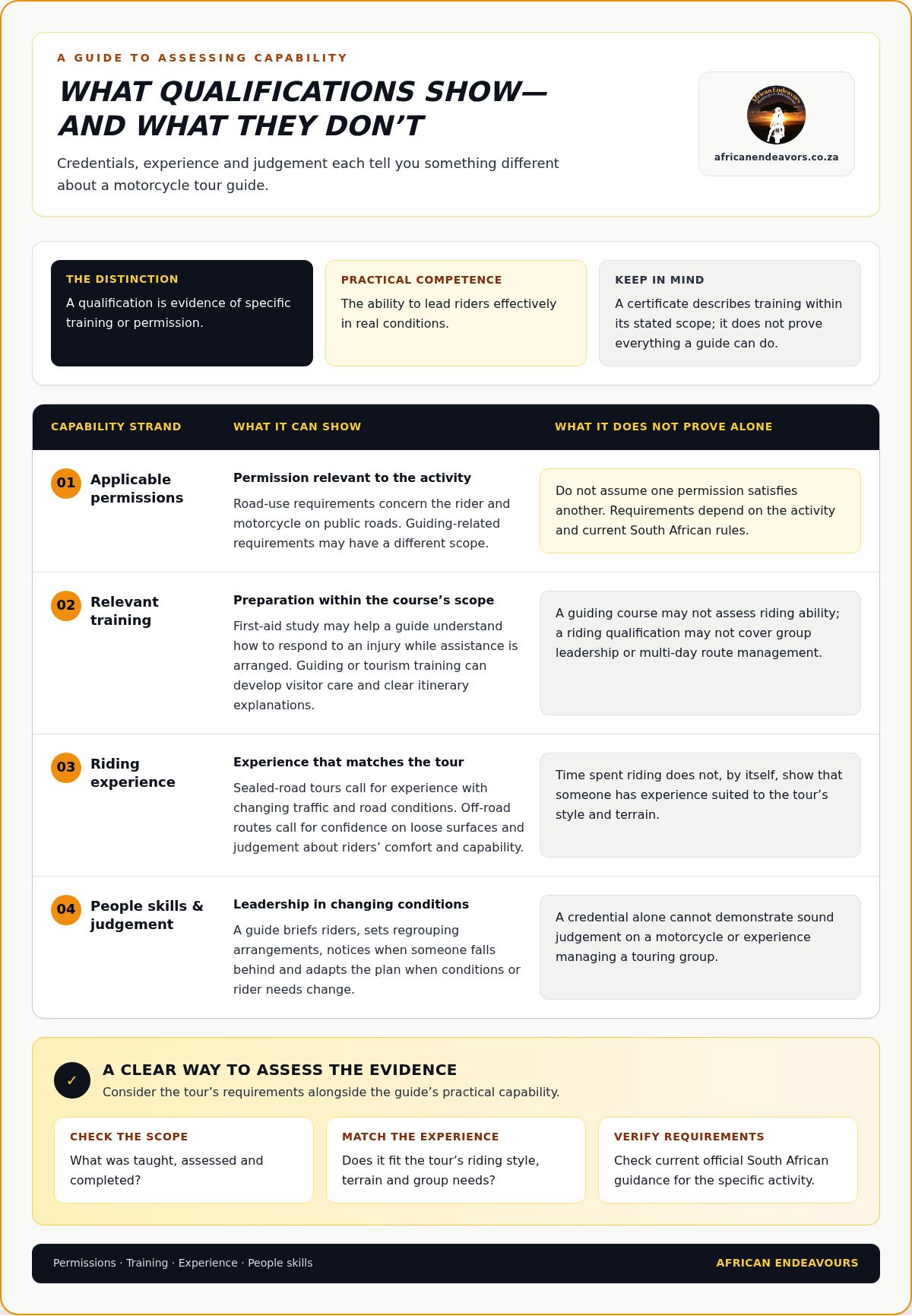
A motorcycle tour guide qualification is evidence of specific training or permission; practical competence is the ability to lead riders effectively in real conditions. The two can complement one another, but they are not interchangeable. A certificate describes training within its stated scope. It does not, by itself, demonstrate sound judgement on a motorcycle or experience managing a touring group.
Touring involves preparation, equipment and logistics as well as riding. The general Motorcycle Touring Overview provides context for the activity; a guide’s role adds the responsibility of leading other people through that experience.
Which qualifications may be formal requirements?
Separate legal permission to ride from rules that may apply to guiding or operating a tour. Road-use requirements concern the rider and motorcycle on public roads. Guiding-related requirements may have a different scope and depend on the activity and current South African rules. Do not assume that one satisfies the other.
Before treating a particular registration or certificate as compulsory, identify the type of tour and check current official South African guidance on the relevant tourism and road-traffic requirements. Rules can change, and different subjects may fall under different authorities. An old checklist, an overseas qualification or a general claim that a guide “is certified” does not establish a specific legal permission.
Which credentials demonstrate specialist preparation?
Training can provide useful evidence of preparation. First-aid study, for example, may help a guide understand how to respond to an injury while assistance is arranged. However, do not describe a particular course as universally mandatory unless a current, applicable rule says so. Formal guiding or tourism training can also develop communication, visitor care and the ability to explain an itinerary clearly.
Assess each credential by its stated scope: what was taught, assessed and completed? Then consider whether that preparation fits motorcycle touring. A guiding course may support visitor care without assessing riding ability; a riding qualification may assess control without covering group leadership or multi-day route management. Neither alone demonstrates experience leading motorcycle tours.
Keep four strands distinct: applicable permissions, relevant training, riding experience and the interpersonal skills needed to manage a group. This makes the phrase motorcycle tour guide qualifications more useful and helps you assess the capabilities the journey actually calls for.
The training and riding skills behind effective motorcycle tour guiding
A guide’s capability shows in everyday decisions: choosing a steady pace, leaving room between bikes, noticing when the group is stretching out and adjusting the plan before a minor issue grows. Effective preparation covers four connected areas: riding capability, route leadership, communication and rider care. A certificate may show that someone studied a skill, but it cannot prove how they will use it under pressure.
Motorcycle tour competence combines relevant training with demonstrated judgement. Riders need a leader who can adapt to the road, terrain and group. The Motorcycle Safety Foundation’s Motorcycle Safety Foundation Training offers a reference point for rider education and safety. Training, wherever it takes place, should be weighed alongside practical experience, not treated as a substitute for it.
Riding experience, route knowledge and group leadership
Look for smooth, predictable riding, clear positioning and a pace that gives others time to react. On a sealed-road tour, relevant experience may include managing changing traffic and road conditions. An off-road route calls for confidence on loose surfaces and the judgement to recognise when conditions exceed a rider’s comfort or capability. Experience should match the tour, not simply the time someone has spent on a motorcycle.
Route leadership starts before the engine turns over. A capable guide prepares the route, understands navigation options and sets clear regrouping points, so riders know what to do after a turn or stop. If weather, road conditions or a rider’s needs make the original plan unsuitable, sound leadership means adapting calmly and explaining the decision.
A short group ride and a multi-day expedition require different kinds of organisation. Over several days, leadership also means maintaining a workable rhythm across successive riding days and keeping the group informed as the itinerary unfolds. Adventure-bike, Harley Davidson and off-road dirt bike tours each call for experience suited to their format.
Communication, first aid and risk awareness
Before setting off, a useful briefing covers the route, riding order, regrouping arrangements and what to do if the group becomes separated. Instructions should be concise and easy to remember. During the ride, a guide needs to notice when someone falls behind, seems uncertain or signals a problem, then respond without confusing the rest of the group.
First-aid training can contribute to preparedness by helping a guide respond appropriately if someone is injured while assistance is arranged. It is one part of rider care, alongside listening, staying composed and recognising when a situation calls for a pause or a revised plan.
Risk assessment is ongoing, not just a form or certificate. Conditions can shift during a ride, so the guide needs to observe the group and surroundings, weigh new information and communicate changes clearly. For riders looking for open-road freedom with considered support, African Endeavors’ fully supported motorcycle safaris combine professional guide services with planned multi-day travel and rider support.
How to compare a motorcycle guide’s credentials with real-world competence
A useful assessment goes beyond a certificate or an impressive riding history. Compare what the guide has learned with what they can demonstrate, and consider how the tour itself is supported. This framework helps you assess the whole experience, but it does not replace checking current legal requirements for the specific activity.
| Area | What it can demonstrate | What it cannot prove alone |
|---|---|---|
| Formal credentials | Structured learning or assessment within a stated subject and scope. | Current legal compliance, unless the credential is verified for that purpose, or sound decisions in every touring situation. |
| Riding experience | Familiarity with a motorcycle, riding conditions or terrain relevant to the tour. | Ability to brief, organise and care for a group. Years of riding alone are not the same as experience leading others. |
| Guiding ability | Clear communication, group management and the ability to adapt an itinerary. | Mechanical expertise, first-aid training or a formal qualification unless these are evidenced separately. |
| Tour support | Practical arrangements for luggage, mechanical assistance and trip logistics. | The guide’s riding judgement or leadership. Support helps the expedition; it does not lead the riders. |
Qualification versus experience: what each can demonstrate
Formal learning gives a guide a framework and may show that particular knowledge or techniques have been studied or assessed. Experience shows how skills have been applied in real conditions, but it needs to be relevant. Extensive riding on sealed roads does not automatically prepare someone to lead an off-road group. Nor does time in the saddle prove that a rider can keep a group together, communicate decisions or respond to a struggling participant. Assess each credential by its verified scope rather than assuming one is superior to another.
Guide capability versus the wider support team
On a multi-day safari, the guide leads the ride and makes decisions with the group in mind. A support vehicle can carry luggage and assist with mechanical needs, helping the riding and logistics work together. It cannot replace the guide’s responsibility for route leadership, communication or adapting the plan. Consider both layers: who leads riders on the road, and what practical support is available if the day brings a delay or mechanical problem?
Imagine a mixed-ability group approaching a rough stretch of track. Relevant riding experience helps a guide judge the terrain; leadership determines whether to regroup, adjust the pace or change the plan. Support arrangements address other practical needs. Motorcycle tour guide qualifications are therefore best assessed alongside relevant experience, guiding ability and expedition support, not as a standalone measure of competence.
Guide qualifications in South Africa: a framework
Start with the activity, not the title of a certificate. A road-based scenic tour, an adventure ride and an off-road safari may call for different riding experience and guiding skills. South African rules may also depend on what the guide and operator are doing, so do not assume one qualification applies to every motorcycle tour.
Use this sequence to assess the requirements:
- Identify the tour type. Establish whether the route is mainly on public roads, includes adventure riding or involves off-road terrain. Note the motorcycle format and the demands riders can expect.
- Identify the guide’s role. Consider whether the person leads the ride, provides visitor guiding, manages a multi-day itinerary or has several responsibilities. Different roles may bring different requirements.
- Verify relevant requirements. Check current South African legislation and official government guidance for the activity and role. Treat a requirement as mandatory only when an authoritative, current source clearly applies.
This sequence helps separate legal obligations from professional recommendations. A course may be valuable preparation without being legally required. Conversely, the existence of a credential does not prove that it meets a particular legal requirement. Keep those questions separate.
How to verify whether a credential is required
Use current legislation and official guidance, not an old blog post, forum discussion or certificate’s marketing description. Check the issuing body, the credential’s stated scope and whether it relates to motorcycle tour guiding or another activity. If the rule’s meaning or application is unclear, seek legal or regulatory verification before presenting it as fact. Requirements can change, so note the source and date of the guidance you rely on.
How to match competence to the tour format
Assess experience against the ride participants will actually undertake. Road-based touring calls for competence suited to public-road conditions and group travel. Adventure routes may require experience on varied surfaces, while off-road riding brings different demands for control and terrain judgement. The route, pace and group’s needs all shape which experience is most useful. No single qualification is a universal measure of every guide.
For example, a credential related to visitor care may support communication but will not necessarily show that its holder has led motorcycle riders over changing terrain. Similarly, a riding course may develop control without covering the organisation of a multi-day group journey. Consider each credential’s scope alongside relevant experience and the guide’s actual responsibilities.
If you are drawn to the measured pace and distinctive character of a cruiser-led journey, explore guided Harley Davidson tours in South Africa. To explore a guided ride shaped around your preferred touring style, discover African Endeavors’ guided motorcycle safaris.
What expert guidance looks like on a fully supported motorcycle safari
A guided safari brings several moving parts together: a planned itinerary, professional guide services and practical support across a multi-day journey. The guide leads the riding each day, helps the group follow the plan and responds when conditions or rider needs change. That leadership is distinct from the logistics that help the expedition run smoothly.
African Endeavors’ tour packages include motorcycle hire, accommodation, fuel and professional guide services. A support vehicle typically carries luggage and provides mechanical assistance, adding practical help without replacing the guide’s responsibility for leading the ride.
How the guide fits into a supported tour
The guide is responsible for the riding experience: leading the group along the planned multi-day itinerary and helping riders understand the day’s arrangements. The support vehicle has a different role, carrying luggage and assisting with mechanical needs so riders do not have to manage those tasks on the road. Together, these roles connect route leadership with the practical demands of travelling over several days.
This distinction matters when assessing motorcycle tour guide qualifications. An organised support structure can contribute to a more manageable journey, but it does not establish a guide’s riding judgement or group-leadership ability. Equally, a capable guide works within a wider plan rather than carrying every logistical responsibility alone. Consider how these elements fit together when assessing a safari.
Choosing an experience that suits your riding style
Start with what you want from the ride. Adventure-bike tours suit riders drawn to varied riding experiences; Harley Davidson scenic tours emphasise the character of the ride, while off-road dirt bike safaris focus on dirt riding. Each format calls for experience that matches its riding style and terrain, as well as an itinerary suited to the group.
Before setting out, consider the kind of riding you enjoy, the conditions you are comfortable with and how much support you want during a multi-day trip. A tour that matches those preferences can make the experience more rewarding, while relevant guide experience helps align the route and pace with the format. African Endeavors’ guided packages bring professional guide services together with planned travel and rider support.
For a guided motorcycle safari with the practical details brought together, explore African Endeavors’ guided safari packages.
Ready to shape a journey around your riding interests? Explore a bespoke motorcycle safari in South Africa.
Choose the journey that feels right
The right motorcycle safari is more than a route on a map. It is shaped by how you want to ride, the terrain that appeals to you and the amount of structure that helps you enjoy the journey. As you consider your options, think about how professional guide services and practical support work together: a support vehicle typically assists with luggage and mechanical needs, while the guide focuses on leading the ride.
Keep that perspective in mind as you weigh motorcycle tour guide qualifications. Credentials matter, but their value is clearer when considered alongside relevant experience and the support behind the journey. The goal is not to collect the longest list of qualifications; it is to choose a guided experience suited to your riding interests and expectations.
Ready to plan a South African adventure? Explore African Endeavors’ guided motorcycle safaris and find a journey that suits your riding interests.
Frequently Asked Questions
What qualifications does a motorcycle tour guide need in South Africa?
There is not one qualification that can safely be described as compulsory for every motorcycle tour guide in South Africa. Requirements may depend on the activity, the guide’s responsibilities and current rules. Separate legal requirements from professionally useful training, and check applicable legislation and official government guidance for the specific tour role. Do not rely on an old online post or assume a certificate’s title proves that it meets a legal requirement.
Is a motorcycle licence enough to lead a guided tour?
No. A motorcycle licence relates to permission to ride within its applicable scope; it does not by itself demonstrate the ability to lead a group. A guide may also need to manage spacing, communicate route changes and make decisions if a rider becomes unwell or a motorcycle stops. Riding competently alone, for example, does not show how someone will keep a group informed at a junction or regroup after a separation.
Can a tour guide qualification replace motorcycle riding experience?
No. A tour-guiding qualification may develop skills such as visitor communication and itinerary management, but it does not automatically demonstrate motorcycle control or experience in the conditions a tour involves. Training to explain points of interest, for example, does not by itself show an ability to lead riders on loose surfaces. Look for evidence that the training and riding experience match the duties and terrain.
Do motorcycle tour guides need first-aid training?
First-aid training can be valuable preparation, but do not assume that one particular course is a universal legal requirement for every guide. Its practical value is clear in a remote setting, where a rider may be injured before further assistance arrives. Training can help someone respond calmly and appropriately within their competence. To establish whether a specific certificate is mandatory, check the current official rule that applies to the guide’s role.
What is the difference between a motorcycle guide and a ride leader?
A ride leader commonly focuses on directing the group during a ride, while a motorcycle tour guide may also take responsibility for the broader touring experience. On a multi-day journey, this can include explaining daily arrangements and helping keep the itinerary on track. The labels can overlap, so judge the actual duties rather than relying on a title alone.
How can I tell whether a motorcycle tour guide is suitably experienced?
Look for experience that matches the ride, not simply a long history of motorcycling. Relevant examples might include leading groups on similar surfaces, managing route changes or adapting the pace for riders with different confidence levels. A clear account of how the guide handles regrouping, navigation and an unexpected delay can reveal more than a general claim of expertise. Also consider whether the experience matches the motorcycle and terrain planned for the tour.
Does a support vehicle replace the motorcycle tour guide?
No. A support vehicle can help with practical needs, such as carrying luggage or providing mechanical assistance, but it does not lead riders or make decisions about the group’s progress. If a motorcycle develops a problem, vehicle support may help address the mechanical issue while the guide manages communication and the riding plan. The roles complement one another, with each contributing differently to an organised safari.
