
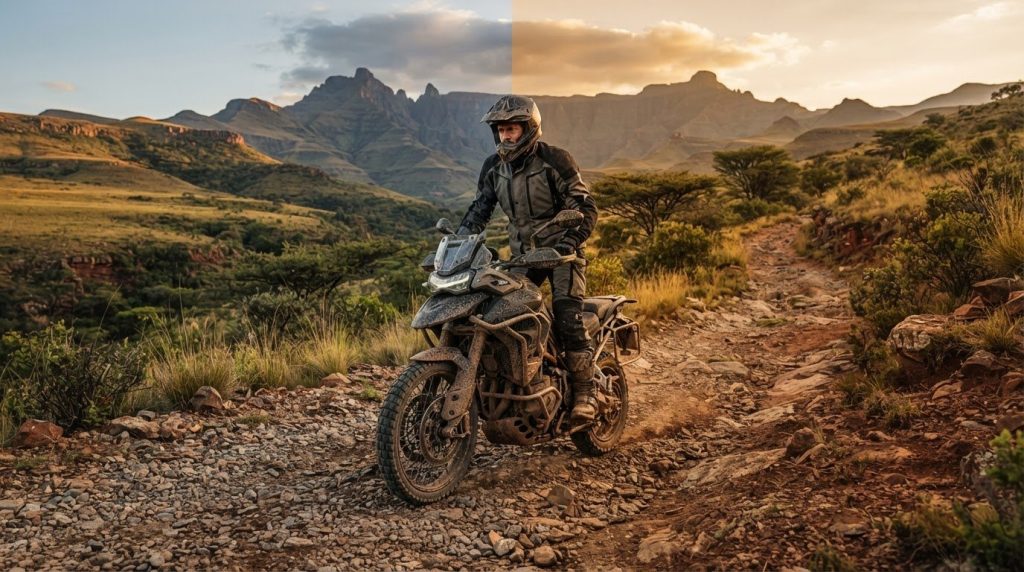
Safer trail control starts with judgement, not speed. Effective off-road riding skills for African trails combine practice on loose ground with steady momentum, careful attention to grip and a pace suited to both the terrain and the rider; motorcycles weighing more than 140 kg can be demanding off-road. In a group, a rider can choose to travel 10% slower than another rider rather than struggle to keep up.
Remote trails bring changing surfaces, ruts and slopes, so confidence comes from sound decisions as well as daring. This guide covers practical ways to build off-road riding skills for African trails, from bike control and group riding to grip and technical terrain. It also explains how preparation and responsible habits help you ride South Africa’s varied off-road routes with greater control.
Key Takeaways
- Build off-road confidence through progressive practice, especially when controlling a heavy adventure motorcycle on loose or uneven ground.
- Use recognised technical skills guidance to shape safer riding habits and responsible conduct on the trail.
- Choose a group pace that lets you stay composed and in control, rather than chasing a faster rider.
- On slippery climbs, balance steady momentum with available grip; abrupt inputs can unsettle the bike.
- Keep your options open in rutted terrain by reading the surface early and choosing your line deliberately.
1. Adventure motorcycle training in off-road conditions
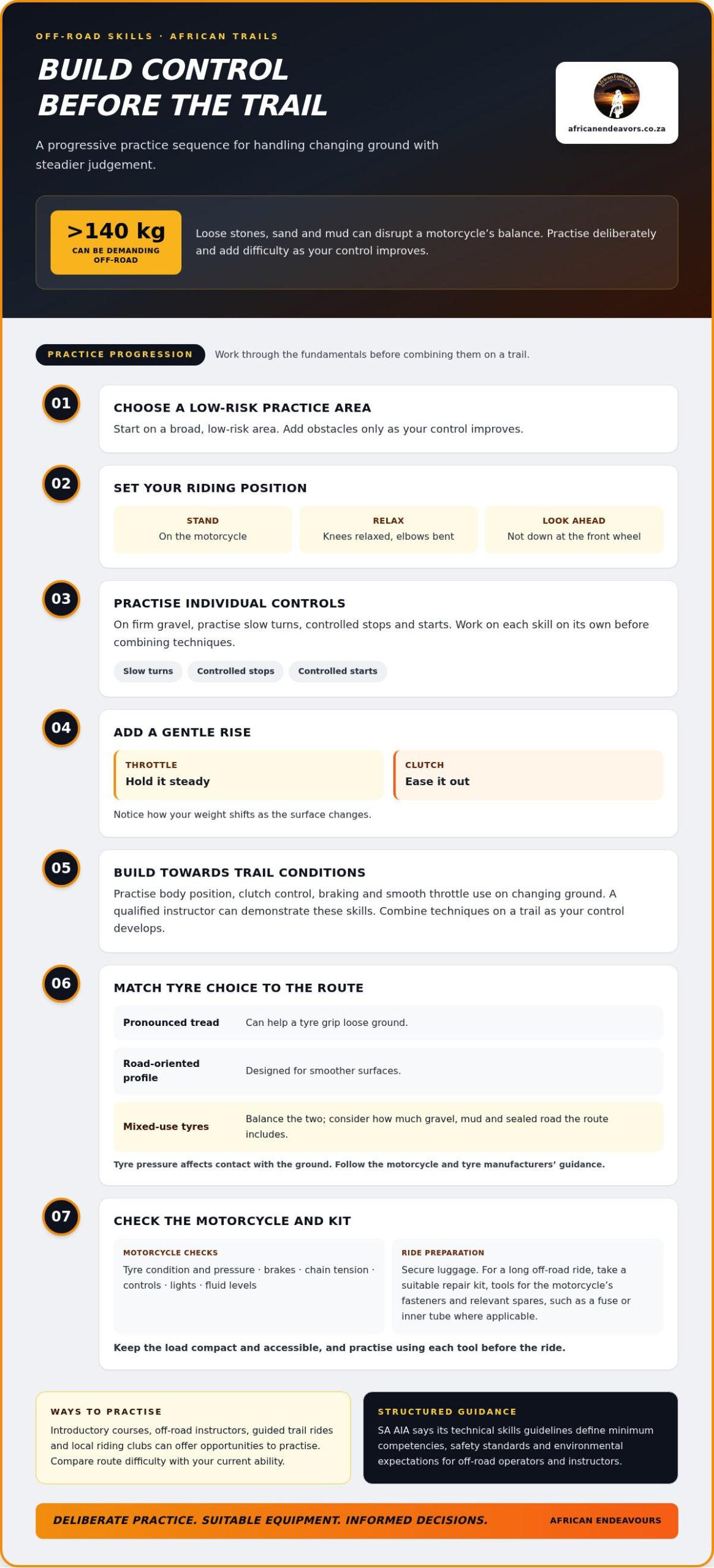
Off-road training turns unfamiliar surfaces into manageable riding decisions. A motorcycle weighing more than 140 kg can be demanding off-road, particularly when loose stones, sand or mud disrupt its balance. Practise first on a broad, low-risk area, then add obstacles as your control improves. A qualified instructor can demonstrate body position, clutch control, braking and smooth throttle use on changing ground.
Practise each skill on its own before combining techniques on a trail. Start by standing with relaxed knees, bent elbows and your eyes looking ahead, not down at the front wheel. Then practise slow turns, controlled stops and starts on firm gravel. On a gentle rise, hold a steady throttle while easing out the clutch. These drills help you feel how your weight shifts as the surface changes.
Adventure-bike tyre profiles affect how a motorcycle behaves on different terrain. A more pronounced tread can help a tyre grip loose ground, while a road-oriented profile is designed for smoother surfaces. Mixed-use tyres balance the two, so consider how much gravel, mud and sealed road your route includes. Tyre pressure also affects contact with the ground. Follow the motorcycle and tyre manufacturers’ guidance.
Before setting out, inspect the motorcycle carefully. Check tyre condition and pressure, brakes, chain tension, controls, lights and fluid levels, then secure your luggage. For a long off-road ride, take a repair kit suited to the motorcycle, tools for its fasteners and relevant spares, such as a fuse or inner tube where applicable. Keep the load compact and accessible, and practise using each tool before the ride.
Beginners can develop off-road skills through introductory courses with motorcycle training schools and off-road instructors. Guided trail rides also offer a chance to practise on off-road routes, while local riding clubs can help newcomers find organised practice and suitable group rides. Before joining a session, compare the route difficulty with your current ability and ask how the training builds fundamental control.
Technical guidance matters alongside individual riding technique. SA AIA says its technical skills guidelines define minimum competencies, safety standards and environmental expectations for off-road operators and instructors. These benchmarks show why structured training should cover safe conduct and responsible trail use as well as bike control. Off-road riding skills for African trails grow through deliberate practice, suitable equipment and informed decisions, not by pushing beyond your current ability.
2. Safety standards and responsible off-road practices
Safety preparation starts before the engine does. Choose a route that matches your ability, check the weather and terrain, and tell someone where you plan to ride. A rocky pass after rain calls for different preparation from a dry gravel track. Check your protective equipment, motorcycle condition and fuel range, then agree on a plan for regrouping if riders become separated.
Use recognised guidance to assess whether instruction covers more than throttle and balance. SA AIA says its technical skills guidelines define minimum competencies, safety standards and environmental expectations for off-road operators and instructors. The scope matters: responsible riding includes preparation, safe conduct and care for the places you cross. Useful training connects practical technique with decisions such as when to stop, choose another line or turn back.
On the trail, ride at a speed that lets you see and react to loose stones, hidden washaways or animals. Slow down near other trail users, settlements and livestock, and avoid sudden acceleration that throws dust or gravel. Stick to established routes instead of cutting across vegetation. If a section feels beyond your control, stop somewhere visible and stable, assess the surface and choose a safer line rather than committing under pressure.
If the motorcycle gets stuck, falls over or breaks down far from help, first move yourself and the bike away from immediate hazards. Alert your group, then assess injuries or damage. Don’t keep forcing a stuck bike: reduce its load, clear loose material and seek help if recovery exceeds your safe ability.
Physical preparation can support steadier decisions late in a ride. Mountain biking develops balance, line choice and the habit of looking ahead, especially on uneven ground. It also lets you practise braking and cornering without managing a motorcycle’s weight. Build your riding time gradually and use varied surfaces, such as gravel and gentle trails, to improve coordination. Cycling ability does not replace motorcycle training.
Prepare for fatigue as carefully as you prepare for terrain. Start rested, drink water during breaks and notice when your grip, concentration or posture begins to deteriorate. If you struggle to hold a controlled line, pause or shorten the ride. In a group, agree that anyone can call for a stop. Shared judgement matters more than pressing on to meet a distance target.
Responsible riding protects people and the landscape. Keep noise and speed considerate near communities, give animals space and take your rubbish with you. Make safe conduct part of the ride, not just a promise made at the trailhead.
3. Adjusting pace when riding in a group
A group moves safely when its pace suits the riders, not the fastest motorcycle. A trail rider may choose to ride 10% slower than another rider rather than struggle to keep up. That choice preserves attention for changing surfaces and gives the rider more time to respond. On South African gravel, a comfortable pace also helps reduce sudden braking and dust clouds.
Agree on the group’s approach before setting off. Decide who leads, who rides at the back and where everyone will regroup after a junction or difficult section. The lead rider should set a pace that lets the least experienced participant ride smoothly. The rear rider watches for delays and signals when the group needs to stop. Keep the plan simple enough to remember on a noisy trail.
Leave enough space to see the ground ahead and react without swerving. On a stony track, following too closely can hide loose rocks beneath the rider in front. In dust, increase the gap or wait for visibility to improve. Don’t assume another rider’s tyre track is the right line for you: it may suit their motorcycle, skill or approach angle instead.
Use clear signals at decision points. A hand gesture or agreed stopping place can tell the group to slow down, regroup or wait, while spoken instructions may be lost over engine noise. At a fork, the lead rider should pause where the route is visible and it is safe to stop. Each rider can then confirm the direction rather than guessing from a disappearing tail-light.
Different surfaces call for different group behaviour. On a steep, loose climb, riders should tackle the section one at a time, leaving space for the motorcycle ahead to clear the obstacle. On a narrow trail, wait at a wider spot before passing or helping another rider. If someone stops unexpectedly, the rider behind should avoid crowding them and calmly alert the group.
Fatigue can affect judgement, so treat pace as an ongoing conversation, not a test of pride. A rider who is tense, missing turns or braking abruptly may need a pause or a slower rhythm. Agree on a signal for stopping and respect it without debate. The aim is controlled progress, not matching the speed of the most confident rider.
Good group control means knowing when to split temporarily or turn back. If a section exceeds one rider’s ability, stop somewhere safe and visible to discuss another line or route. Don’t pressure anyone to attempt an obstacle just because the rest of the group has crossed it. A measured pace keeps the ride coordinated and gives every rider room to make deliberate choices.
4. Balancing momentum and grip
On loose ground, a motorcycle needs enough forward momentum to keep moving, but too much throttle can break traction. A muddy climb makes the balance clear: too little drive may leave the rear tyre spinning or the bike bogged down. Read the slope before entering, choose a line with fewer deep ruts and use smooth throttle instead of a sudden burst. Look along the path ahead, not down at the wheel.
Consider the example of a muddy slope with a 15-degree incline. A steady 10 mph is one example of a pace that may help a motorcycle climb. It isn’t a universal target: mud depth, tyre condition, motorcycle weight and rider control all affect available grip. Treat the example as a way to understand momentum, not a speed instruction for every South African trail.
Dropping below the pace needed to carry the bike uphill can remove the momentum required to keep climbing. On that muddy slope, travelling a couple of miles per hour slower than the suggested 10 mph example may leave the bike without enough grip to climb. Conversely, about 2 or 3 mph extra in the example may help prevent the motorcycle losing grip and getting bogged down. Smooth application matters; abrupt acceleration can spin the rear tyre.
Before a climb, assess the surface and decide where you’ll go if your chosen line fails. If you can safely maintain steady progress, avoid stopping halfway: restarting on a slippery incline takes control. Stay relaxed and let the motorcycle move beneath you. If the tyre starts to spin, don’t simply add throttle. Ease off, regain control and reassess your line.
Tyres and surface conditions affect how momentum translates into traction. A tyre with a suitable off-road tread can grip loose material, while packed mud may behave differently from wet clay. Check the route and tyre condition before setting out, and follow the motorcycle manufacturer’s pressure recommendations. The right tyre choice depends on terrain, load and the balance between off-road grip and road riding.
Practise on a gentle, open incline before attempting a steep or rutted climb. Approach at a controlled pace, keep the throttle steady and notice how the rear tyre responds. If firm gravel gives way to slick mud, stop somewhere safe and reassess rather than carrying speed blindly onto the new surface. Momentum should be deliberate and matched to the grip available.
On descents, balance calls for restraint rather than extra speed. Choose a manageable line before heading downhill, keep your inputs smooth and avoid grabbing the brakes on slippery ground. If the surface becomes unstable, slow down in a controlled way and leave room to stop. Good trail control comes from reading each slope and adjusting momentum to its actual grip.
5. Technical skills guidelines
Core off-road riding skills for African trails include controlled braking, smooth throttle use, clutch control, line choice and balance. Practise each separately before combining them on uneven ground. In a clear practice area, rehearse slow turns, controlled stops and steady starts. These exercises help you understand how the motorcycle responds before you add ruts, loose stones or slopes.
On sand, gravel, mud and rocks, look ahead and choose a line before reaching an obstacle. On loose sand, keep movements smooth and avoid abrupt braking. On gravel, slow down before a bend, then steer steadily through it. On rocks, choose a path around sharp edges where possible, and avoid sudden throttle or brake inputs that could unsettle the motorcycle.
A muddy slope needs measured momentum. On a muddy slope with a 15-degree incline, 10 mph is an example of a steady speed that may help a motorcycle climb. It isn’t a universal target; surface, tyre condition, motorcycle and rider control affect grip. Read the climb first, select a suitable line and avoid sharp throttle changes once you begin ascending.
Ruts call for early decisions. Beginners can start by riding along the raised centre between trail ruts when possible, keeping the option of choosing a rut later. Check its depth and direction before committing. On wet ground, avoid standing unnecessarily while changing direction over ruts. A beginner may lose the front end and have difficulty putting a foot down steadily.
Position and braking matter on descents as well as climbs. Stay relaxed, look towards your intended path and use smooth controls over uneven ground. When slowing to a stop, especially downhill, keep the clutch engaged almost until the engine stalls. Practise this sequence on a gentle slope first so you can focus on how the motorcycle responds.
If you’re stuck, assess the surface before trying to move again. Tyre pressure could be reduced to 12 psi when a rider is stuck on a trail, then reinflated to the manufacturer’s recommended pressure afterwards. Use this only as a recovery measure, and carry a way to reinflate the tyre. Lower pressure can affect tyre support, particularly on rocky terrain.
SA AIA’s technical skills guidelines define minimum competencies, safety standards and environmental expectations for off-road operators and instructors. Use that framework to judge whether training covers practical control, safe decisions and responsible trail conduct, rather than isolated tricks. The key is to practise on suitable terrain, master each technique and progress to harder surfaces as your control develops.
Ready to put trail skills into practice? Explore guided off-road riding and experience South Africa’s rugged routes with support.
African Endeavors: The Wild Coast & Drakensberg Tour
The Wild Coast & Drakensberg Tour offers a guided way to experience South Africa’s varied riding landscapes. It’s a natural next step for riders who have developed foundational control and want to apply their skills on a planned motorcycle journey. For a dedicated off-road focus, African Endeavors also offers Off-Road Dirt Bike Safaris.
A guided tour suits riders looking for a structured adventure rather than the task of planning trails independently. Keep practising core techniques and choose a ride that matches your ability and comfort on changing surfaces. The Wild Coast and Drakensberg offer a striking setting for measured progress, from coastal scenery to mountain roads.
To explore a tour or discuss your riding plans, contact African Endeavors or visit africanendeavors.co.za.
Take your next ride with confidence
Building off-road riding skills for African trails isn’t about conquering every obstacle. It’s about developing judgement you can carry between landscapes: reading the ground, choosing a measured response and knowing when to pause. That mindset makes every ride more rewarding, whether you’re refining your technique or planning a new journey through South Africa.
The next step is to match the experience to the kind of riding you want. African Endeavors offers The Kruger Park & Panorama Route Tour and The Garden Route & Route 62 Tour, each presenting a different way to explore the country by motorcycle. Consider the scenery and riding experience you’re drawn to, then shape your plans around it.
Contact African Endeavors about your ride and take the first step towards discovering South Africa from the saddle.
Frequently Asked Questions
How should beginners practise standing, balance, braking and throttle control on a dirt bike?
Practise each movement separately in a clear, level area before combining them. With the engine off, stand on the pegs and shift your weight gently to feel how the bike responds. Then ride slowly through a broad turning space, keeping your arms relaxed and looking towards your exit. Add smooth stops and starts with light throttle and clutch input. Ask an instructor to observe your posture and help correct habits early.
What tyre pressures and tyre types work best for different African trail surfaces?
There’s no single pressure that suits every tyre, motorcycle, load and surface. Use the motorcycle and tyre manufacturers’ recommended pressure as your reference, and choose a tread suited to the mix of terrain you expect. A recovery measure is different: pressure could be reduced to 12 psi when stuck on a trail, then reinflated to the manufacturer’s recommended pressure afterwards. Carry a way to reinflate before attempting this.
What riding gear and protective equipment are recommended for off-road motorcycling in South Africa?
Choose a properly fitting motorcycle helmet, eye protection, gloves, a protective jacket and trousers, and sturdy riding boots. On rocky tracks, add protective gear for your knees, elbows and torso that doesn’t restrict movement. Check fastenings, closures and wear before each ride: loose clothing can snag, and damaged gear may not provide its intended protection. Pack a lightweight waterproof layer for changing conditions and keep essentials accessible.
What are common hazards on African trails, including wildlife, heat, river crossings and remote terrain?
Expect loose surfaces, sudden weather changes, wildlife, heat, water and limited access to assistance. Give animals space and never block their path. At a river crossing, assess the depth, current, entry and exit before approaching. Don’t enter if you can’t judge a safe line. In remote terrain, carry water, tell someone your route and turn back when conditions exceed your ability or your group’s preparation.
What are South Africa’s rules for riding off-road motorcycles on public roads, trails and protected land?
Treat public roads, trails and protected land as different settings. On public roads, ensure the motorcycle and rider meet applicable South African road requirements. On trails, stay on routes where motorcycle access is authorised. Protected land may have its own access conditions, so follow the land manager’s instructions. Don’t assume a visible track is open to riding. Respect closures, signs and local access arrangements throughout your journey.
